Artemis II Flight Day 3: NASA Cancels First Outbound Trajectory Correction Burn as Orion Remains Perfectly on Course

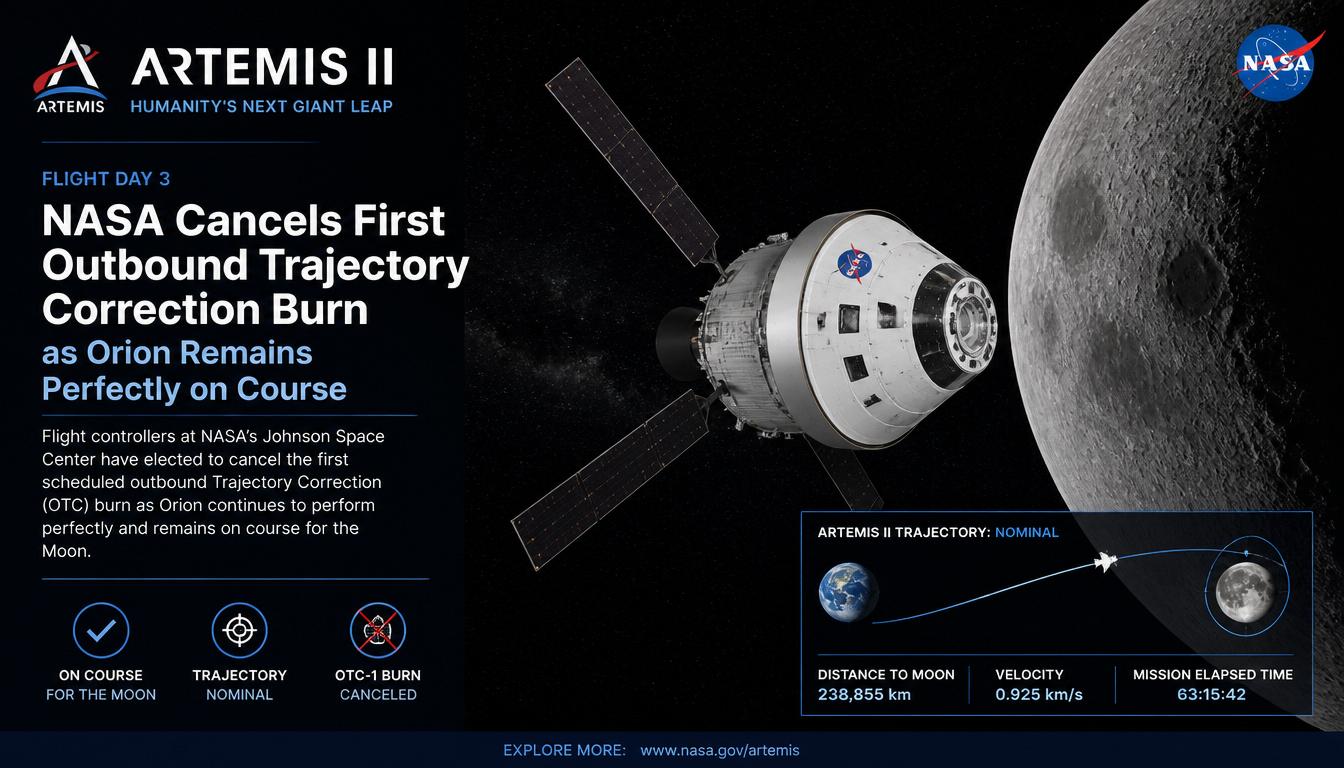
Artemis II Flight Day 3: NASA Cancels First Outbound Trajectory Correction Burn as Orion Remains Perfectly on Course
NASA’s Artemis II mission continues progressing successfully as flight controllers confirmed that the Orion spacecraft remains precisely on its planned trajectory toward the Moon. Because of Orion’s highly accurate flight path, mission controllers made the important decision to cancel the spacecraft’s first outbound trajectory correction burn.
The announcement represents another major success for the Artemis II mission, highlighting the incredible accuracy of Orion’s navigation and propulsion systems during deep space travel.
NASA engineers explained that the spacecraft is already traveling along the correct route needed for its planned lunar flyby on Monday, April 6, eliminating the need for the scheduled adjustment burn.
The Artemis II mission continues making history as the first crewed journey beyond Earth orbit since the Apollo program ended in 1972.
The astronauts aboard Orion include NASA crew members Reid Wiseman, Victor Glover, Christina Koch, and Canadian astronaut Jeremy Hansen.
NASA Confirms Orion Is Following the Correct Flight Path
Flight controllers working inside mission control at NASA’s Johnson Space Center carefully reviewed Orion’s navigation data before making the decision to cancel the first outbound trajectory correction burn.
After analyzing the spacecraft’s speed, orientation, and flight path, engineers determined that Orion remained extremely close to its planned course toward the Moon.
This meant the spacecraft did not require the scheduled correction maneuver to adjust its trajectory.
The decision highlights the remarkable precision of Orion’s earlier orbital maneuvers, including the successful translunar injection burn that sent the crew beyond Earth orbit.
NASA officials explained that Orion continues operating normally as it travels deeper into space.
What Is a Trajectory Correction Burn?
Trajectory correction burns are planned engine firings used to slightly adjust a spacecraft’s direction or speed during space missions.
These maneuvers are extremely important during deep space travel because spacecraft must follow very precise flight paths over enormous distances.
Even tiny navigation errors can become much larger over time if left uncorrected. Because of this, NASA schedules multiple correction opportunities throughout missions like Artemis II.
The planned outbound trajectory correction burn would have used Orion’s thrusters to fine-tune the spacecraft’s route toward the Moon.
However, since Orion was already flying along the correct path, NASA determined the maneuver was unnecessary.
Why Canceling the Burn Is Actually Good News
Although some people may think canceling a planned maneuver sounds concerning, NASA officials explained that it is actually a very positive sign for the mission.
The cancellation means Orion’s navigation systems, propulsion systems, and previous orbital maneuvers performed with extremely high accuracy.
By avoiding an unnecessary burn, NASA also conserves fuel, which provides additional operational flexibility later in the mission if needed.
Fuel conservation is very important during deep space missions because spacecraft carry limited propellant supplies for navigation, trajectory corrections, and future operations.
The decision demonstrates the efficiency and reliability of Orion’s onboard systems and NASA’s flight planning calculations.
Orion Continues Historic Journey Toward the Moon
As Artemis II continues its journey, Orion remains on track for its planned lunar flyby scheduled for Monday, April 6.
The mission has already achieved several historic milestones, including becoming the first crewed mission to leave Earth orbit since Apollo 17 in 1972.
NASA’s Artemis program represents humanity’s return to deep space exploration after more than five decades focused primarily on missions in low Earth orbit.
The successful progress of Artemis II continues building confidence in NASA’s ability to safely send astronauts farther into space in preparation for future Moon landings and Mars missions.
Translunar Injection Burn Set Orion on Precise Course
One of the main reasons Orion remains so accurately aligned is the success of the translunar injection burn completed earlier in the mission.
During that major maneuver, Orion’s service module engine fired for nearly six minutes, accelerating the spacecraft out of Earth orbit and onto a trajectory toward the Moon.
NASA engineers carefully calculated every aspect of the maneuver to ensure Orion entered the correct path through deep space.
The fact that the spacecraft now requires no immediate trajectory correction shows just how accurate the translunar injection burn truly was.
Flight controllers continue monitoring Orion’s path around the clock to ensure the spacecraft remains perfectly aligned during the outbound journey.
Mission Control Teams Monitor Orion 24 Hours a Day
Inside mission control, groups of engineers and flight experts constantly keep track of Orion’s systems and flight path.
NASA’s mission control center at Johnson Space Center in Houston serves as the primary operations hub for Artemis II.
Flight controllers carefully track spacecraft speed, orientation, fuel usage, communication systems, crew health data, and navigation accuracy.
These teams are responsible for identifying any potential issues and deciding whether correction maneuvers are necessary during the mission.
The successful decision to skip the outbound trajectory correction burn reflects the high confidence mission control currently has in Orion’s flight performance.
Three Trajectory Correction Opportunities Planned
NASA originally planned three separate trajectory correction opportunities during Artemis II.
These correction windows allow engineers to make adjustments if Orion drifts slightly from its planned route during the journey to the Moon.
Because the first burn was canceled, any future adjustments that may become necessary can still be incorporated into later correction opportunities.
This flexible mission planning approach helps NASA maintain precise navigation while also conserving spacecraft fuel whenever possible.
Future correction burns will only occur if engineers determine that Orion’s trajectory requires refinement during later mission stages.
Orion’s Navigation Systems Continue Performing Well
The successful flight path accuracy demonstrates the strength of Orion’s advanced navigation systems.
Deep space missions require spacecraft to maintain extremely precise positioning while traveling hundreds of thousands of miles from Earth.
Unlike aircraft or vehicles on Earth, Orion cannot rely on GPS systems while traveling toward the Moon. Instead, the spacecraft uses onboard computers, sensors, star trackers, and communication data to determine its exact position and orientation in space.
NASA engineers continue gathering valuable navigation data during Artemis II that will help improve future deep space missions.
The mission serves as an important real-world test of Orion’s guidance and navigation technology.
Artemis II Crew Continues Daily Space Operations
While mission control monitors Orion’s flight path, the astronauts aboard the spacecraft continue carrying out daily mission activities.
The crew remains focused on spacecraft operations, scientific preparations, exercise sessions, communication tests, and health demonstrations during the journey.
NASA designed Artemis II not only to test Orion’s spacecraft systems but also to evaluate how astronauts perform during deep space missions.
Every activity completed aboard Orion helps NASA prepare for future lunar exploration missions that may involve longer durations and more complex operations.
The crew continues adapting to life in deep space while traveling farther from Earth each day.
Upcoming Lunar Flyby Will Provide Historic Views
One of the most anticipated moments of the mission will occur during Orion’s lunar flyby.
NASA plans for the spacecraft to loop around the Moon while astronauts conduct detailed observations of the lunar surface, including parts of the Moon’s far side that are never visible from Earth.
Scientists are especially interested in studying craters, ancient lava plains, ridges, and other geological formations that may reveal important clues about the Moon’s history.
The crew also is expected to capture high-resolution images of the Moon and deep space during the flyby.
These observations may provide valuable scientific data while also inspiring millions of people around the world.
Artemis II Continues Building the Future of Lunar Exploration
The Artemis II mission plays a major role in NASA’s long-term plans for human exploration beyond Earth.
Unlike the Apollo program, Artemis aims to establish sustainable exploration near and on the Moon using advanced spacecraft systems, lunar habitats, and future space infrastructure.
The knowledge gained during Artemis II will help NASA prepare for future missions that eventually return astronauts to the lunar surface.
Every successful operation, including the precise trajectory now being maintained by Orion, helps strengthen confidence in the technologies needed for future exploration.
NASA officials continue describing Artemis II as one of the most important preparation missions in modern spaceflight history.
Frequently Asked Questions (FAQs)
Why did NASA cancel the outbound trajectory correction burn?
NASA canceled the burn because Orion was already following the correct flight path toward the Moon.
What is a trajectory correction burn?
It is a planned engine firing used to adjust a spacecraft’s speed or direction during a mission.
Is canceling the burn a problem for the mission?
No, it is actually good news because it shows Orion’s trajectory is extremely accurate.
How many trajectory correction burns are planned during Artemis II?
NASA originally planned three correction opportunities during the mission.
Who are the astronauts aboard Orion?
The crew includes Reid Wiseman, Victor Glover, Christina Koch, and Jeremy Hansen.
Why is fuel conservation important in space missions?
Spacecraft carry limited fuel supplies, so avoiding unnecessary burns helps preserve propellant for future mission needs.
When will Orion fly by the Moon?
The spacecraft is scheduled to fly by the Moon on Monday, April 6.
Why is Artemis II historically important?
It is the first crewed mission to travel beyond Earth orbit since the Apollo program ended in 1972.