Artemis II Flight Day 2: Orion Successfully Completes Translunar Injection Burn and Begins Historic Journey to the Moon

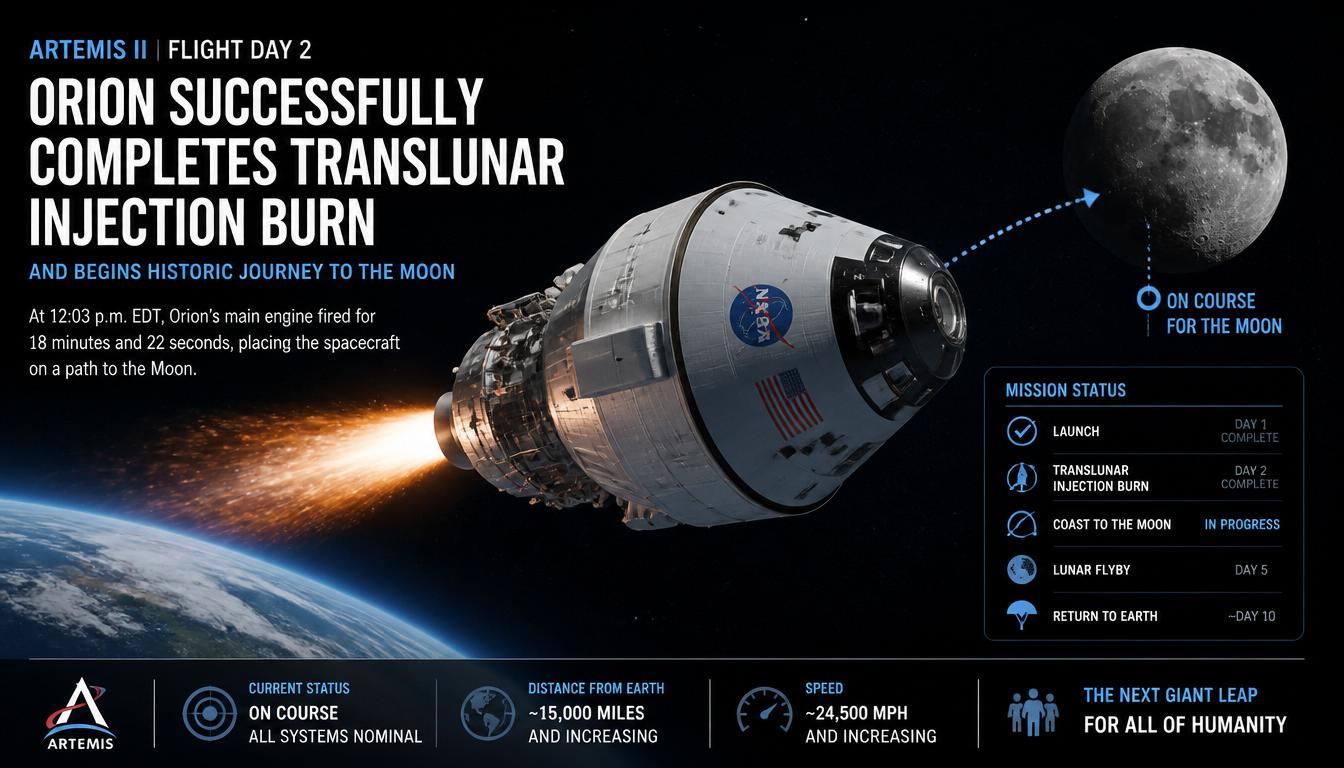
Artemis II Flight Day 2: Orion Successfully Completes Translunar Injection Burn and Begins Historic Journey to the Moon
NASA’s Artemis II mission has officially entered deep space after the Orion spacecraft successfully completed the powerful translunar injection (TLI) burn, sending astronauts on a historic journey toward the Moon for the first time since the Apollo era.
The major milestone marks one of the most important moments in modern human space exploration. Following approval from NASA’s mission management team, Orion ignited its main engine for five minutes and 50 seconds beginning at 7:49 p.m. EDT, successfully leaving Earth orbit and setting course for the Moon.
The Artemis II mission represents humanity’s return to deep space travel more than 50 years after Apollo 17 became the last crewed mission to travel beyond low Earth orbit in 1972.
Aboard the Orion spacecraft are NASA astronauts Reid Wiseman, Victor Glover, Christina Koch, and Canadian astronaut Jeremy Hansen.
Orion Successfully Leaves Earth Orbit
The translunar injection burn officially pushed Orion beyond Earth orbit and onto a trajectory toward the Moon.
NASA engineers confirmed that the spacecraft’s main engine performed exactly as planned during the nearly six-minute firing. The burn generated enough speed to allow Orion to break free from Earth’s immediate gravitational influence and begin its journey through deep space.
At the time of the maneuver, Orion weighed approximately 58,000 pounds and consumed around 1,000 pounds of fuel during the burn.
The successful operation represents a critical achievement because even small errors during the translunar injection burn could have affected Orion’s lunar trajectory.
NASA flight controllers closely monitored propulsion systems, navigation data, and spacecraft guidance throughout the maneuver to ensure the spacecraft remained perfectly aligned.
Orion’s Main Engine Demonstrates Powerful Performance
The Orion spacecraft relies on its service module’s main engine to perform major orbital maneuvers during the Artemis II mission.
NASA explained that the engine can generate up to 6,700 pounds of thrust. To demonstrate its power, the agency compared the acceleration capability to a car reaching 0 to 60 miles per hour in approximately 2.7 seconds.
Although spacecraft engines operate differently in space, the comparison helps illustrate the incredible force required to move astronauts beyond Earth orbit.
The engine’s performance during the translunar injection burn confirmed that Orion’s propulsion systems are capable of supporting future lunar missions and deep space exploration.
Artemis II Crew Begins Deep Space Operations
With Orion now traveling toward the Moon, the Artemis II astronauts have officially begun deep space mission operations.
The crew continues conducting daily spacecraft activities, monitoring onboard systems, and preparing for upcoming lunar observations. Astronauts are also adapting to life in deep space as the mission moves farther from Earth.
Unlike missions in low Earth orbit, deep space travel presents unique challenges because astronauts must operate with greater independence and reduced communication delays.
NASA designed Artemis II to test both spacecraft systems and human performance during long-distance spaceflight before future lunar landing missions begin.
Astronauts Use Flywheel Exercise Device in Space
One important part of the mission involves maintaining astronaut health during space travel.
The Artemis II crew has begun exercising using Orion’s flywheel exercise device, a compact system specifically designed for deep space missions.
Exercise is extremely important in microgravity because astronauts can quickly lose muscle strength and bone density without regular physical activity. NASA carefully plans workout routines to help astronauts remain healthy and physically prepared for reentry to Earth.
The flywheel device supports both aerobic exercises such as rowing and strength-building exercises like squats and deadlifts.
How Orion’s Flywheel Exercise System Works
Unlike the large exercise equipment aboard the International Space Station, Orion’s exercise system was built to fit within the limited space available inside the spacecraft.
The flywheel device operates using a cable-based mechanism similar to a yo-yo. Resistance increases depending on how much force the astronaut applies, allowing workouts with loads up to 400 pounds.
NASA engineers designed the system to be lightweight and compact while still supporting astronaut fitness needs during deep space missions.
The entire flywheel system weighs only around 30 pounds and is roughly the size of a carry-on suitcase. This makes it ideal for future missions where spacecraft mass and storage space are extremely limited.
NASA Monitors Spacecraft Environment During Exercise
While astronauts exercise aboard Orion, NASA teams on the ground carefully monitor the spacecraft’s environmental systems.
Engineers specifically observed Orion’s air revitalization system, which maintains a breathable and comfortable atmosphere inside the spacecraft cabin.
Exercise activities can slightly affect spacecraft movement and cabin conditions, so engineers analyze how astronaut workouts influence Orion’s systems during flight.
The information gathered during Artemis II will help NASA improve spacecraft life-support systems and astronaut health procedures for future lunar and Mars missions.
AVATAR Scientific Payload Successfully Tested
The Artemis II crew also successfully completed testing of the AVATAR scientific payload during Flight Day 2.
Although NASA has not released full details about every scientific experiment onboard, the successful checkout confirms that Orion’s scientific systems continue operating normally during deep space travel.
Scientific payloads aboard Artemis II are designed to help researchers study human spaceflight conditions, spacecraft performance, and deep space environments.
The mission serves not only as a test flight but also as an important scientific opportunity for future exploration planning.
NASA Resolves Temporary Communication Issue
NASA engineers also investigated a brief communications issue that occurred shortly after Orion reached orbit.
According to mission officials, there was a short loss of two-way communication between the spacecraft and ground teams. Engineers later determined that the problem was caused by a ground configuration issue involving the Tracking and Data Relay Satellite system.
The issue was resolved quickly and had no impact on the mission or crew safety.
NASA emphasized that Orion’s systems continued functioning normally throughout the temporary communications interruption.
Lunar Science Team Begins Planning Moon Observations
Following the successful translunar injection burn, NASA’s lunar science team immediately began preparing for Orion’s upcoming Moon flyby observations.
The team is developing a Lunar Targeting Plan that will guide astronauts during approximately six hours of lunar observations scheduled for Monday, April 6.
The observation plan will focus on studying important lunar surface features that may help scientists better understand the Moon’s formation and geological history.
Researchers are especially interested in ancient craters, lava flows, cracks, and ridges that reveal how the Moon evolved over billions of years.
Artemis II Crew Will Observe a Solar Eclipse Near the Moon
One of the most exciting events planned during Orion’s lunar flyby is a solar eclipse observation.
During the eclipse, the Sun will move behind the Moon from Orion’s perspective, creating a rare opportunity for astronauts to study both the lunar surface and deep space conditions.
NASA explained that astronauts may be able to observe flashes caused by meteoroids striking the Moon’s surface, along with dust particles rising above the lunar horizon.
The crew will also observe the Sun’s outer atmosphere, known as the corona, while the Moon blocks the bright central portion of the Sun.
These observations could provide valuable scientific information about both the Moon and solar activity.
Artemis II Opens a New Chapter in Human Space Exploration
The Artemis II mission represents one of NASA’s most important modern achievements.
For the first time in more than five decades, astronauts are once again traveling beyond low Earth orbit and returning to the Moon’s neighborhood.
The mission serves as a major preparation step for future Artemis missions that aim to land astronauts on the Moon, establish sustainable lunar operations, and eventually support human missions to Mars.
Each successful maneuver, scientific experiment, and crew activity carried out on Orion strengthens NASA’s confidence in the future of deep space exploration.
As Artemis II continues its journey toward the Moon, millions around the world are watching history unfold once again.
Frequently Asked Questions (FAQs)
What is the translunar injection burn?
The translunar injection burn is a major engine firing that sends the Orion spacecraft out of Earth orbit and toward the Moon.
How long did Orion’s TLI burn last?
The burn lasted approximately five minutes and 50 seconds.
What quantity of fuel did Orion consume while performing the burn?
NASA reported that Orion used around 1,000 pounds of fuel during the maneuver.
Who are the astronauts aboard Artemis II?
The crew includes Reid Wiseman, Victor Glover, Christina Koch, and Jeremy Hansen.
Why do astronauts exercise during space missions?
Exercise helps astronauts maintain muscle strength and bone health in microgravity environments.
What is Orion’s flywheel exercise device?
It is a compact exercise system designed to support astronaut fitness during deep space missions.
Did Artemis II experience any communication problems?
NASA reported a brief communications issue caused by a ground configuration problem, but it was resolved quickly with no mission impact.
What will astronauts study during the Moon flyby?
The crew will observe lunar craters, lava flows, ridges, solar eclipse events, and other scientific targets near the Moon.