Progress 95 Cargo Mission Prepares for Launch as ISS Crew Completes Busy Week of Research

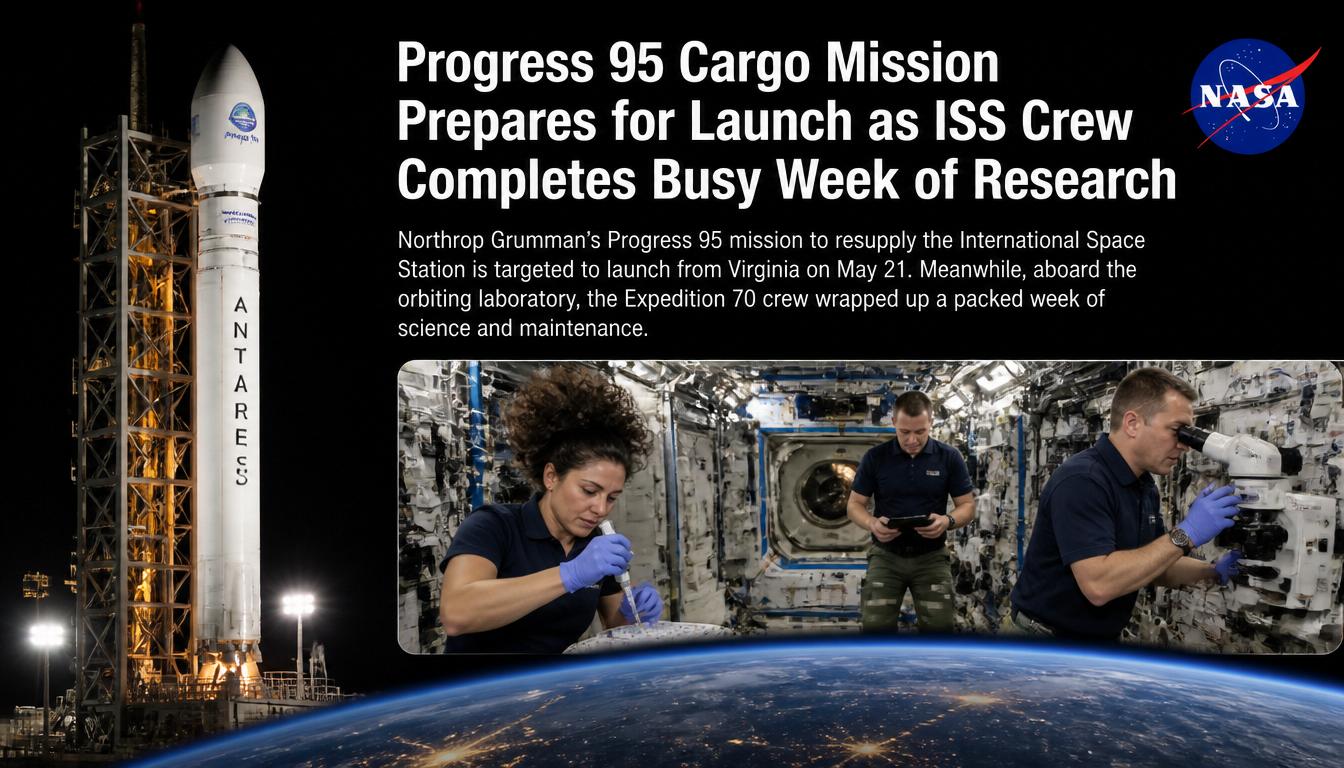
Progress 95 Cargo Mission Prepares for Launch as ISS Crew Completes Busy Week of Research
Life aboard the International Space Station (ISS) remained highly active as the Expedition 74 crew wrapped up another productive week filled with scientific experiments, health monitoring, and station maintenance. At the same time, anticipation continued building for the upcoming launch of the Progress 95 cargo spacecraft from the Baikonur Cosmodrome in Kazakhstan.
The cargo mission is expected to deliver several tons of supplies, fuel, food, and scientific equipment to support astronauts living and working aboard the orbiting laboratory. While mission teams on Earth prepared for launch operations, astronauts aboard the ISS focused on a variety of important investigations designed to improve human health, space manufacturing, and long-duration exploration capabilities.
The station crew also celebrated the arrival of fresh food delivered aboard Northrop Grumman’s Cygnus XL cargo spacecraft, providing astronauts with a welcome nutritional and psychological boost during their months-long mission in space.
Progress 95 Cargo Spacecraft Ready for Launch
The Russian Progress 95 spacecraft stood fully assembled atop its launch pad at the historic Baikonur Cosmodrome as mission controllers counted down toward liftoff.
The spacecraft was scheduled to launch aboard a Soyuz rocket and begin a two-day orbital journey before automatically docking with the International Space Station. Cargo missions like Progress 95 are essential because they provide the orbital laboratory with critical resources needed to sustain daily operations.
The spacecraft is carrying approximately three tons of cargo, including:
- Food supplies for astronauts
- Fuel for orbital adjustments
- Water and oxygen equipment
- Scientific hardware
- Maintenance tools
- Crew support supplies
Once in orbit, Progress 95 will carefully maneuver toward the station before docking automatically with the Zvezda service module’s rear port.
Why Cargo Missions Are Critical for the ISS
The International Space Station depends heavily on regular cargo deliveries from multiple international partners. Without resupply missions, astronauts would quickly run out of essential materials needed for survival and scientific work.
Cargo spacecraft perform several important tasks:
- Delivering fresh food
- Carrying research experiments
- Transporting replacement equipment
- Providing fuel for orbital reboosts
- Removing station waste
The ISS continuously loses altitude due to Earth’s atmospheric drag. Cargo spacecraft often carry fuel that helps raise the station’s orbit and maintain its operational altitude.
These missions also support future deep-space exploration by testing technologies and logistics systems required for Moon and Mars missions.
Astronauts Conduct Advanced Health Research
While the Progress spacecraft prepared for launch, astronauts aboard the ISS focused heavily on biomedical studies aimed at protecting crew health during long-duration missions.
NASA astronauts Chris Williams and Jack Hathaway spent part of their day inside the Columbus laboratory module conducting cardiovascular health experiments. The pair performed blood pressure measurements and Ultrasound 3 scans on veins located in the neck, shoulders, and legs.
Doctors on Earth monitored the procedures in real time and analyzed the biomedical data to understand how microgravity affects circulation and cardiovascular function.
Long-term exposure to space can lead to:
- Fluid shifts toward the upper body
- Changes in blood circulation
- Muscle weakening
- Bone density loss
- Cardiovascular stress
Understanding these effects is essential before astronauts can safely travel to Mars or spend extended periods on the Moon.
The European Enhanced Exploration Exercise Device Undergoes Testing
Chris Williams also evaluated the performance of the new European Enhanced Exploration Exercise Device, commonly known as E4D.
Exercise is one of the most important daily routines aboard the ISS because astronauts experience rapid muscle and bone loss in microgravity. The E4D system is being tested as a next-generation exercise device designed specifically for future exploration missions.
Scientists hope the new equipment will:
- Maintain astronaut fitness
- Reduce muscle atrophy
- Protect bone density
- Improve cardiovascular health
- Support deep-space missions
Future journeys to Mars may last several years, making advanced exercise systems essential for astronaut survival and mission success.
Cygnus XL Cargo Spacecraft Continues Supporting the Crew
The recently arrived Cygnus XL cargo spacecraft continued playing an important role aboard the ISS.
Jack Hathaway unpacked newly delivered medical kits and pharmaceutical supplies from inside the cargo spacecraft. These supplies help astronauts maintain health and prepare for possible emergencies during long-duration missions.
Cygnus XL carried a wide variety of cargo, including:
- Medical equipment
- Research hardware
- Scientific samples
- Food supplies
- Crew clothing
- Maintenance tools
Fresh fruits and vegetables delivered aboard the spacecraft also provided astronauts with a morale boost. Crew members celebrated the arrival of oranges, apples, peppers, and onions—foods rarely available during long missions in orbit.
Fresh food is important not only for nutrition but also for mental well-being during extended stays in space.
Jessica Meir Trains for Medical Emergencies in Orbit
NASA astronaut Jessica Meir spent part of her day training with the Health Maintenance System, a critical onboard medical support system.
Astronauts aboard the ISS must be prepared to handle medical emergencies independently because immediate evacuation to Earth is not always possible.
The training included:
- Emergency medical procedures
- Crew health monitoring
- Injury treatment techniques
- Emergency response planning
- Use of onboard medical equipment
Space agencies continuously improve medical systems to prepare astronauts for future deep-space missions where help from Earth may be days or weeks away.
After completing her training, Meir assisted Hathaway with unpacking supplies from Cygnus XL and later replaced laptop computers inside the Destiny laboratory module.
ESA Astronaut Studies Crystal Formation in Space
ESA astronaut Sophie Adenot conducted fascinating physics research involving colloidal crystal samples.
Colloidal crystals are microscopic particles that naturally organize themselves into highly ordered structures. Researchers think these substances may find significant industrial uses down the line.
Adenot photographed the crystal samples as part of the 3D Colloidal Crystals experiment, which aims to explore how advanced materials can be manufactured in space.
Potential applications include:
- High-performance electronics
- Optical technologies
- Advanced sensors
- Space manufacturing systems
- New industrial materials
Microgravity allows these crystal structures to form more evenly than on Earth, giving researchers valuable insights into material science.
Space Botany Continues Inspiring Future Generations
Sophie Adenot also watered seeds for an educational botany experiment designed to inspire students to pursue careers in science and space exploration.
Growing plants in space is becoming increasingly important as agencies prepare for future Moon and Mars habitats.
Space agriculture research focuses on:
- Sustainable food production
- Oxygen generation
- Carbon dioxide recycling
- Closed-loop life support systems
Scientists hope future astronauts will eventually grow their own food during deep-space missions.
Roscosmos Cosmonauts Conduct Hearing and Fitness Tests
Russian cosmonauts Sergey Kud-Sverchkov and Sergei Mikaev participated in hearing examinations aboard the station.
The tests took place inside the quiet Quest airlock where the crew used specialized computerized systems to evaluate hearing sensitivity.
The microgravity environment can impact multiple body systems, such as balance and hearing, which makes regular monitoring critically important.
Later, Kud-Sverchkov inspected the Elektron oxygen generator located inside the Zvezda service module. This system produces oxygen for the crew by splitting water molecules.
Meanwhile, Mikaev completed a treadmill fitness test to monitor cardiovascular health and physical performance in microgravity.
Station Maintenance Remains a Daily Priority
Roscosmos flight engineer Andrey Fedyaev focused on station maintenance activities throughout the day.
He cleaned ventilation systems inside the Zarya module and replaced smoke detectors inside the Nauka science module.
Routine maintenance is critical aboard the ISS because every onboard system supports astronaut safety and station operations.
Crew members regularly inspect:
- Air filtration systems
- Electrical equipment
- Water recycling systems
- Ventilation hardware
- Fire detection systems
These maintenance tasks ensure the space station remains safe and fully operational.
ISS Research Supports Future Moon and Mars Missions
The tasks currently being carried out on the ISS are establishing the groundwork for humanity’s future in deep space.
Scientists are using the station to test technologies and conduct experiments that will help astronauts survive on:
- The Moon
- Mars
- Deep-space stations
- Long-duration exploration missions
Research involving health monitoring, advanced exercise devices, plant growth, and material science will all contribute to future exploration programs.
The ISS continues to serve as humanity’s most advanced space laboratory and a vital stepping stone toward future interplanetary missions.
FAQs
What is the purpose of the Progress 95 mission?
The Progress 95 cargo spacecraft is delivering food, fuel, scientific equipment, and supplies to support astronauts aboard the International Space Station.
Why are cargo missions important for the ISS?
Cargo missions provide essential resources such as food, oxygen equipment, research hardware, and fuel needed to keep the ISS operational.
What is the E4D exercise device?
The European Enhanced Exploration Exercise Device (E4D) is an advanced workout system being tested to help astronauts maintain muscle and bone health during long-duration space missions.
Why do astronauts study cardiovascular health in space?
Microgravity affects blood circulation and heart function. Studying these effects helps protect astronaut health during future Moon and Mars missions.
What are colloidal crystals?
Colloidal crystals are microscopic particles that organize into crystal-like structures. Scientists study them for use in advanced electronics and industrial materials.
Why is plant research important in space?
Plant research helps scientists develop sustainable food production systems and life support technologies for future deep-space missions.
Suggested AI Image Prompts
Image 1
“International Space Station crew celebrating fresh food delivery in zero gravity, realistic astronauts floating inside ISS”
Image 2
“Progress cargo spacecraft launching from Baikonur Cosmodrome at sunset, cinematic rocket launch scene”
Image 3
“Astronaut conducting ultrasound health scan aboard the International Space Station, futuristic medical equipment”
Image 4
“Advanced exercise machine inside the International Space Station, astronaut training in microgravity”
Image 5
“Space crystal manufacturing experiment inside futuristic orbital laboratory, glowing microscopic structures”