DNA Research Aboard Space Station Could Revolutionize Cancer Treatment and Radiation Recovery in 2026

DNA Research Aboard Space Station Could Revolutionize Cancer Treatment and Radiation Recovery in 2026
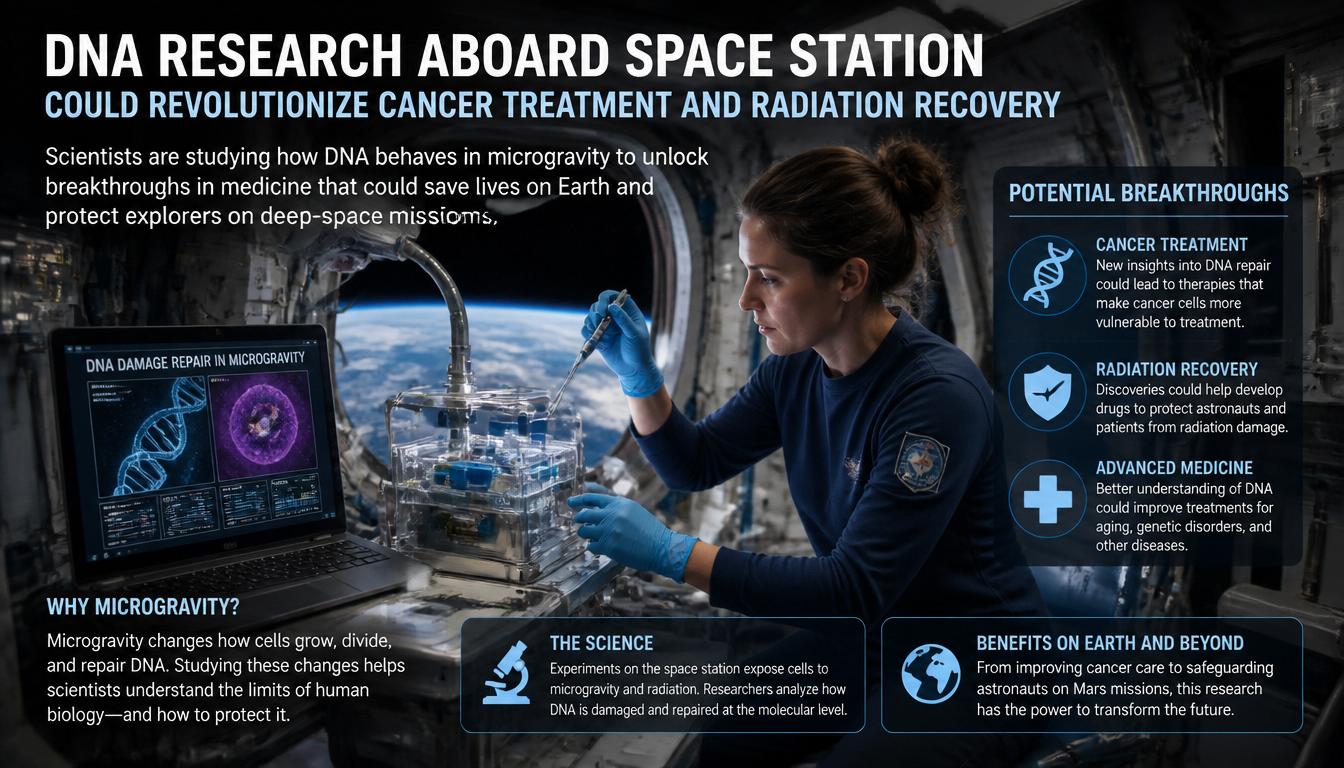
The International Space Station continues to serve as one of humanity’s most advanced scientific laboratories, helping researchers unlock discoveries impossible to achieve on Earth. On Wednesday, Expedition 74 astronauts focused heavily on biotechnology experiments involving DNA and DNA-inspired nanomaterials that could one day transform cancer treatments, improve radiation repair systems, and support future deep-space missions.
Scientists are using the unique microgravity environment aboard the orbiting laboratory to better understand how biological materials behave when gravity is removed from the equation. These studies are opening doors to innovative medical therapies, advanced pharmaceutical manufacturing, and new technologies designed to keep astronauts healthy during missions to the Moon, Mars, and beyond.
Alongside the scientific work, the crew also completed the installation of a new advanced exercise system, tested cutting-edge virtual reality vision equipment, and continued unpacking supplies delivered by Northrop Grumman’s Cygnus XL cargo spacecraft.
Space Biotechnology Research Continues to Expand
Biotechnology research has become one of the most important scientific priorities aboard the International Space Station. The microgravity environment allows scientists to observe cellular behavior, protein assembly, and DNA interactions in ways that are difficult or impossible on Earth.
Gravity influences nearly every biological process. When gravity is removed, researchers can study how cells grow, repair themselves, and interact under entirely different conditions. These observations can reveal hidden biological mechanisms that may improve medicine and healthcare.
The Expedition 74 crew worked on several advanced investigations focused on DNA structures, cancer-fighting nano-therapies, and radiation damage repair. The findings from these studies may benefit not only astronauts but also millions of patients on Earth.
As space agencies and private companies continue investing in biotechnology research, the International Space Station is increasingly becoming a center for medical innovation and commercial scientific development.
DNA Nano Therapeutics Experiment Could Change Cancer Treatment
NASA astronaut Chris Williams and ESA astronaut Sophie Adenot spent much of their day inside the Kibo laboratory module processing genetic material samples for the DNA Nano Therapeutics-3 experiment.
This groundbreaking investigation studies DNA-inspired assembly techniques that could be used to manufacture highly advanced nano-therapies. These therapies may eventually help doctors target cancer cells more precisely while reducing harmful side effects associated with traditional treatments like chemotherapy.
Researchers are particularly interested in how tiny DNA-based structures assemble themselves in microgravity. On Earth, gravity can interfere with the formation of these delicate nanomaterials. In space, however, scientists can study their development under more stable conditions.
The goal is to create nano-scale delivery systems capable of transporting medicines directly to diseased cells inside the human body. This could make treatments more effective and safer for patients.
Scientists believe this technology may eventually support both chemotherapy and immunotherapy treatments. Immunotherapy works by activating the body’s immune system to attack cancer cells naturally.
The samples created during the experiment are first analyzed aboard the station using specialized scientific equipment. Later, they are returned to Earth for additional testing in laboratories.
Microgravity Helps Scientists Understand DNA Behavior
One reason space research is so valuable is because microgravity changes the way biological molecules behave.
DNA structures can assemble more evenly in orbit because they are not being pulled downward by gravity. This allows researchers to observe how molecules organize themselves naturally.
Scientists are learning how DNA-based nanomaterials may be designed more efficiently for future medical applications. These materials could one day carry drugs, repair damaged tissue, or even deliver genetic therapies directly into cells.
The research may also help scientists understand diseases at a molecular level, leading to faster and more accurate treatments.
Microgravity has already helped researchers make important discoveries in protein growth and pharmaceutical manufacturing. DNA nanotechnology may become the next major scientific breakthrough enabled by space research.
Lux in Space Study Investigates Radiation Damage Repair
NASA astronaut Jessica Meir focused on another important biotechnology investigation called Lux in Space while working inside the Columbus laboratory module.
This experiment studies how DNA damaged by space radiation repairs itself in microgravity.
Radiation is one of the greatest dangers astronauts face during long-duration missions beyond Earth’s protective magnetic field. Exposure to radiation can damage cells and DNA, increasing the risk of cancer and other serious health problems.
Scientists hope to understand how biological systems respond to radiation damage in space so they can develop better protection methods for astronauts.
The findings could also prove advantageous for people living on Earth. Radiation therapy is commonly used to treat cancer patients, but it can also damage healthy cells. Learning how DNA repairs itself could lead to safer radiation treatments and improved recovery methods.
Jessica Meir worked with the station’s BioLab incubator, which supports studies involving microorganisms and biological samples in microgravity.
The maintenance and operation of this advanced scientific hardware are essential for keeping the experiments running successfully.
Advanced Exercise Device Installed for Future Moon and Mars Missions
In addition to biotechnology work, the Expedition 74 crew also completed the setup of the European Enhanced Exploration Exercise Device, or E4D.
Astronauts lose muscle strength and bone density while living in microgravity. Regular exercise is necessary to maintain their physical health during space missions.
The E4D system is being tested to determine whether it can support astronaut fitness on future deep-space missions to the Moon and Mars.
Jessica Meir inspected and secured power connections for the exercise machine inside the Columbus laboratory module to ensure it was functioning properly.
Future exploration missions may last months or even years, making advanced workout systems extremely important for astronaut survival and performance.
The E4D represents the next generation of space exercise technology designed specifically for long-duration missions.
Virtual Reality Goggles Tested to Protect Astronaut Vision
Another important technology tested aboard the station involved the Nevada Vision Screening System.
Jessica Meir reviewed the head-mounted virtual reality device, which is designed to monitor and protect astronaut eyesight during spaceflight.
Vision problems are common during long-term missions because microgravity changes fluid distribution inside the body. Increased pressure around the eyes can affect vision and alter the shape of the eyeball.
The virtual reality system measures visual performance and helps doctors monitor how spaceflight affects astronaut eyesight over time.
Protecting astronaut vision is especially important for future missions to Mars, where crews may spend years away from Earth.
The development of advanced medical monitoring systems like this also has potential applications for healthcare on Earth.
Cargo Operations Continue After Cygnus XL Arrival
NASA astronaut Jack Hathaway spent much of his day supporting scientific activities and continuing cargo operations following the recent arrival of Northrop Grumman’s Cygnus XL spacecraft.
The cargo vehicle delivered thousands of pounds of scientific equipment, research samples, and crew supplies to the station.
Hathaway activated Kibo’s Life Science Glovebox, allowing Williams and Adenot to safely process genetic materials for the DNA Nano Therapeutics study.
He also photographed scientific procedures for documentation purposes and continued unpacking supplies from Cygnus XL.
Additionally, Hathaway restocked the Human Research Facility inside the Columbus laboratory with important medical supplies, including gloves, needles, blood tube kits, and electrodes.
Efficient cargo management is critical aboard the station because astronauts rely on resupply missions to maintain research operations and daily life.
Roscosmos Crew Conducts Fitness and Spacecraft Preparations
Meanwhile, the Roscosmos cosmonauts aboard the station focused on fitness testing and spacecraft preparation activities.
Flight engineer Sergei Mikaev participated in a cardiovascular fitness evaluation while pedaling on an exercise cycle connected to sensors measuring heart activity. Andrey Fedyaev assisted with the test and later checked the operation of the treadmill inside the Zvezda service module.
Regular fitness monitoring helps doctors understand how spaceflight affects the human body and ensures astronauts remain healthy during their missions.
Later, Mikaev and station commander Sergey Kud-Sverchkov configured simulation hardware for the upcoming Progress 95 cargo mission scheduled to arrive later in April.
The crew practiced automated rendezvous and docking procedures to prepare for the spacecraft’s arrival.
Kud-Sverchkov also replaced battery units inside the Zarya module’s power system, helping maintain the station’s electrical infrastructure.
International Space Station Continues Leading Scientific Discovery
The International Space Station remains one of the most important scientific platforms ever built. Every experiment performed aboard the station contributes valuable knowledge that supports medicine, technology, and human exploration.
The DNA Nano Therapeutics and Lux in Space investigations are examples of how space research may directly improve life on Earth. From cancer treatments and radiation protection to advanced medical monitoring systems, the benefits of these studies extend far beyond the boundaries of space exploration.
As humanity prepares for future missions to the Moon, Mars, and beyond, the research conducted aboard the station will play a critical role in ensuring astronauts remain healthy and capable during deep-space journeys.
At the same time, these discoveries are helping scientists create new medical technologies that could transform healthcare for future generations.
FAQs
What is the DNA Nano Therapeutics-3 experiment?
The DNA Nano Therapeutics-3 experiment studies DNA-inspired nanomaterials that may help create advanced cancer treatments and targeted drug delivery systems.
Why is microgravity important for DNA research?
Microgravity allows scientists to observe how DNA structures naturally assemble without the interference of gravity, improving research accuracy.
How could this research improve cancer therapies?
Researchers hope DNA-based nano-therapies can deliver medicines directly to cancer cells while reducing side effects from traditional treatments.
What is the Lux in Space investigation?
Lux in Space studies how DNA damaged by space radiation repairs itself in microgravity to improve radiation protection methods.
Why do astronauts need advanced exercise equipment?
Astronauts lose muscle and bone strength in microgravity, so advanced workout systems help maintain their physical health during missions.
What is the E4D exercise device?
The European Enhanced Exploration Exercise Device is a next-generation workout system designed for future Moon and Mars missions.
Why are astronauts testing virtual reality goggles?
The VR system monitors astronaut eyesight and helps doctors understand how spaceflight affects vision during long-term missions.
How does the International Space Station help medical research?
The station provides a unique microgravity environment where scientists can study biological processes impossible to observe on Earth.
What role does Cygnus XL play in station operations?
Cygnus XL delivers scientific equipment, experiments, crew supplies, and other cargo needed to support station missions.
How can space research benefit people on Earth?
Space research contributes to advancements in medicine, biotechnology, disease treatment, and healthcare technologies that improve life on Earth.

1 comment