Artemis II Flight Day 3: Orion Crew Prepares for First Trajectory Correction Burn and Lunar Observation Mission

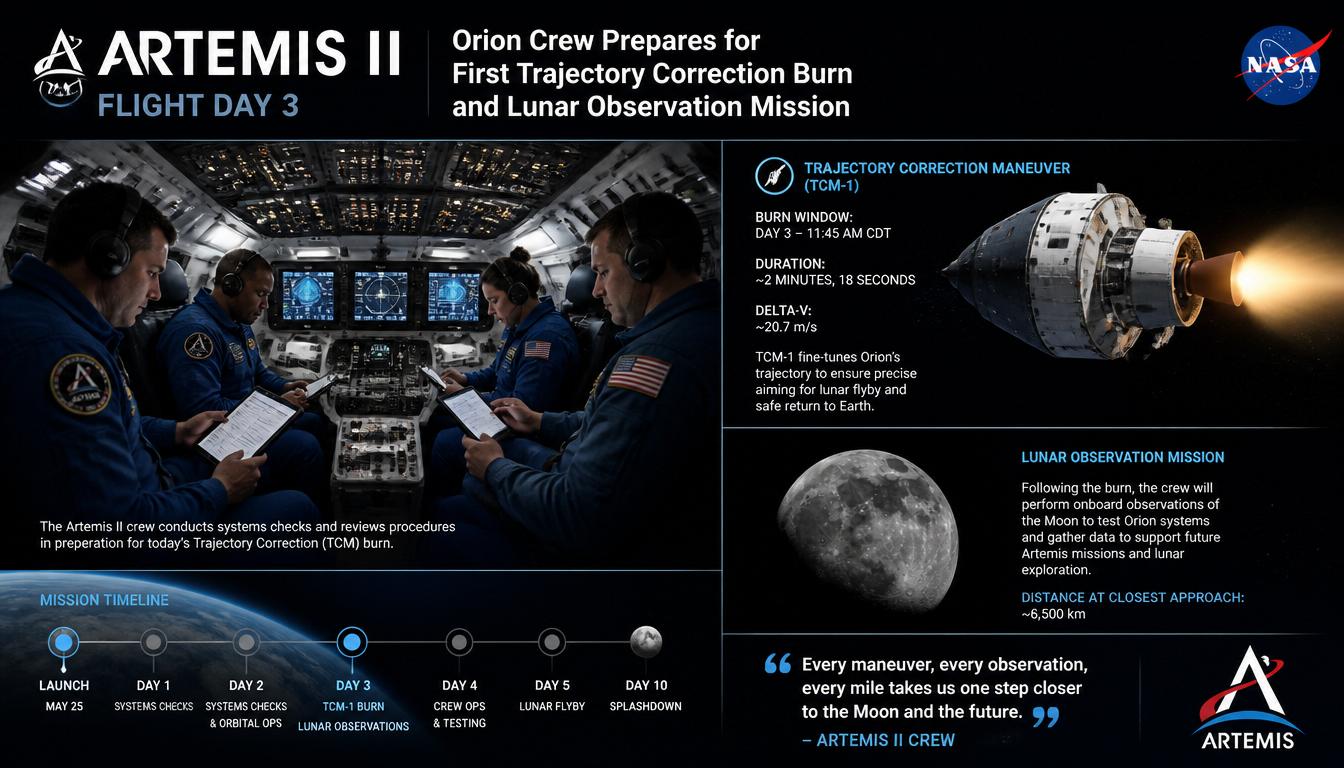
Artemis II Flight Day 3: Orion Crew Prepares for First Trajectory Correction Burn and Lunar Observation Mission
NASA’s Artemis II mission continues its historic deep space journey as the Orion spacecraft crew prepares for the mission’s first outbound trajectory correction burn while also getting ready for an important lunar science observation assignment during the upcoming Moon flyby.
Flight Day 3 marks another major milestone for the Artemis II astronauts as they continue adjusting to life in deep space after successfully leaving Earth orbit. The mission is currently carrying humans farther from Earth than any crewed mission since the Apollo era ended in 1972.
The Orion spacecraft, carrying NASA astronauts Reid Wiseman, Victor Glover, Christina Koch, and Canadian astronaut Jeremy Hansen, is steadily traveling toward the Moon after completing the successful translunar injection burn on April 2, 2026.
Artemis II Crew Officially Begins Deep Space Operations
After completing the powerful translunar injection burn and taking an approximately eight-hour rest period, the Artemis II crew officially began their second full day in deep space.
NASA confirmed that the astronauts became the first humans to leave Earth orbit since the Apollo program concluded over 50 years ago. This achievement represents one of the most important moments in modern human spaceflight history.
The astronauts were awakened at 1 p.m. by mission control teams at NASA’s Johnson Space Center in Houston. Eastern Daylight Time, accompanied by playing the song “…In a Daydream” by the Freddy Jones Band. The crew immediately began another busy schedule focused on spacecraft operations, trajectory corrections, lunar science preparations, and astronaut health demonstrations.
Orion Continues Traveling Toward the Moon
At the time of wake-up, Orion and its crew were approximately 99,900 statute miles away from Earth and steadily approaching the Moon, which was about 161,750 statute miles ahead of the spacecraft.
The growing distance from Earth highlights how quickly Orion is traveling through deep space after the successful translunar injection burn.
As the spacecraft continues its journey, mission controllers constantly monitor Orion’s systems, communications, navigation data, and crew health to ensure everything remains stable during the outbound trip.
According to NASA engineers, Orion remains in normal operating condition as it travels farther from Earth than any crewed spacecraft has in many decades.
First Outbound Trajectory Correction Burn Scheduled
One of the most important activities planned for Flight Day 3 is the first outbound trajectory correction burn, also known as the OTC burn.
NASA scheduled the maneuver for approximately 6:49 p.m. EDT. The burn is expected to last around eight seconds and slightly change Orion’s velocity by 0.7 feet per second.
Although the adjustment sounds small, trajectory correction burns are extremely important during deep space missions because even tiny changes in spacecraft speed or direction can significantly affect the final flight path over long distances.
The maneuver will use Orion’s onboard thrusters to fine-tune the spacecraft’s route toward the Moon.
Why Trajectory Correction Burns Matter
Trajectory correction burns play a vital role during missions traveling beyond Earth orbit.
After major maneuvers like the translunar injection burn, spacecraft may require small adjustments to remain perfectly aligned with their intended destination. These corrections help ensure Orion arrives at the precise location needed for future lunar operations.
NASA engineers plan these maneuvers with great care because traveling through deep space demands extremely precise navigation.
Even a very small departure from the intended route could impact upcoming flyby activities, observation timelines, or the flight paths back to Earth.
The successful completion of these burns demonstrates the accuracy and reliability of Orion’s propulsion and navigation systems.
Lunar Science Team Prepares Observation Assignment
While astronauts continue their journey toward the Moon, NASA’s lunar science team is preparing a detailed observation assignment for the crew.
Scientists at mission control are selecting important geological features on the Moon that astronauts will observe during Orion’s lunar flyby scheduled for Monday, April 6.
The lunar science observation period is expected to last approximately six hours and will provide astronauts with a unique opportunity to study parts of the Moon rarely seen by humans.
Researchers hope the observations will provide valuable scientific information about the Moon’s formation, geology, and surface evolution.
The crew is set to observe the side of the Moon that faces away from Earth.
One of the most exciting aspects of the upcoming lunar flyby is that the Artemis II crew will observe parts of the Moon’s far side.
NASA explained that approximately 20% of the Moon’s far-side hemisphere will be illuminated by sunlight during the observation period.
The far side of the Moon is never visible directly from Earth, making this a rare opportunity for astronauts to study areas that few humans have ever seen in person.
Visible features will include the famous Orientale basin, Pierazzo crater, and Ohm crater. Some of these geological structures have never been viewed directly with the unaided human eye.
The observations may help scientists better understand how the Moon and the solar system formed billions of years ago.
Orion Crew Practices Lunar Observation Procedures
Inside the Orion spacecraft, astronauts are also practicing how to prepare the cabin for lunar observation activities.
Because Orion’s cabin space is relatively compact — roughly comparable to the size of two minivans — astronauts must carefully coordinate their movements while operating in microgravity conditions.
The crew is rehearsing equipment configuration, camera placement, and coordinated movements to guarantee the lunar observation session proceeds without issues.
NASA emphasized that proper organization inside the spacecraft becomes extremely important during complex mission operations.
Astronauts Prepare Specialized Camera Equipment
To support the lunar observation mission, astronauts are configuring specialized handheld camera systems inside Orion.
The crew will use both 80–400 millimeter lenses and 14–24 millimeter lenses during the lunar flyby to capture detailed images of the Moon’s surface.
These high-quality images may help scientists study lunar craters, ridges, lava plains, and other geological formations in greater detail.
NASA also expects the images to provide stunning visual documentation of humanity’s return to deep space exploration.
The photographs captured during Artemis II could become some of the most iconic space images since the Apollo era.
Crew Performs CPR and Medical Emergency Demonstrations
In addition to scientific and navigation activities, the Artemis II crew is also conducting health and emergency response demonstrations aboard Orion.
Astronauts will practice CPR and choking response procedures to evaluate how emergency medical operations can be performed in the microgravity environment of deep space.
Medical preparedness is extremely important during long-duration missions because astronauts traveling far from Earth may need to handle emergencies without immediate outside assistance.
NASA uses Artemis II to study how astronauts perform emergency procedures while operating inside a spacecraft during deep space travel.
The lessons learned will help improve medical systems and crew safety protocols for future Moon and Mars missions.
Exercise Remains Important During Deep Space Travel
All four Artemis II astronauts continue participating in daily exercise sessions using Orion’s flywheel exercise system.
Exercise remains critical during space missions because microgravity environments can weaken muscles and reduce bone density over time.
The flywheel device allows astronauts to perform both cardiovascular and strength-building exercises despite Orion’s limited cabin space.
NASA carefully monitors astronaut fitness and physical conditioning during Artemis II because future lunar and Mars missions may require astronauts to remain healthy during much longer journeys.
Christina Koch puts Orion’s emergency communication system to the test.
Later in the day, astronaut Christina Koch will test Orion’s emergency communication systems using NASA’s Deep Space Network.
The test is designed to verify that Orion can maintain reliable communication with Earth as the spacecraft travels farther into deep space.
NASA confirmed that the Orion Artemis II Optical Communications System successfully connected with two ground stations located in the United States.
The system transmitted high-definition video and mission data directly from Orion back to mission control in Houston.
Reliable communication systems are essential during deep space missions because astronauts must remain connected with Earth across enormous distances.
Orion’s Optical Communication System Demonstrates New Technology
The optical communications system aboard Orion represents an important advancement in deep space communication technology.
Unlike traditional radio communication systems, optical communications can potentially transmit larger amounts of data more efficiently using laser-based technology.
This allows NASA to send high-definition video, scientific information, and spacecraft telemetry between deep space missions and Earth more effectively.
Future Moon and Mars missions may rely heavily on advanced optical communication systems to support astronauts living far from Earth.
Artemis II provides NASA with an important opportunity to test these systems during a real deep space mission.
Artemis II is continuing to usher in a new era of space exploration.
Every successful operation aboard Orion continues moving NASA closer to its long-term exploration goals.
The Artemis II mission serves as a major preparation step for future Artemis missions that will attempt lunar landings and establish sustainable human exploration near the Moon.
The knowledge gained from trajectory correction maneuvers, deep space communications, lunar observations, and astronaut health demonstrations will directly support future missions to the Moon and eventually Mars.
As Orion continues its journey toward the Moon, Artemis II is already making history as humanity’s return to deep space exploration enters a new chapter.
Frequently Asked Questions (FAQs)
What is the outbound trajectory correction burn?
The outbound trajectory correction burn involves a brief firing of the engine to fine-tune Orion’s route as it heads toward the Moon.
Why are trajectory correction burns important?
They help ensure the spacecraft stays precisely aligned with its planned route during deep space travel.
What was Orion’s distance from Earth on the third day of the flight?
NASA reported that Orion was approximately 99,900 statute miles from Earth.
What parts of the Moon will the crew observe?
Astronauts will study parts of the Moon’s far side, including the Orientale basin, Pierazzo crater, and Ohm crater.
Why is the Moon’s far side important?
The far side contains geological features that can help scientists understand the Moon’s formation and evolution.
What exercise equipment does Orion use?
The crew uses a compact flywheel exercise device designed for deep space missions.
What communication system is being tested aboard Orion?
Christina Koch is testing Orion’s emergency communications and optical communications systems using NASA’s Deep Space Network.
Why is Artemis II historically important?
It is the first crewed mission to travel beyond Earth orbit since the Apollo program ended in 1972.