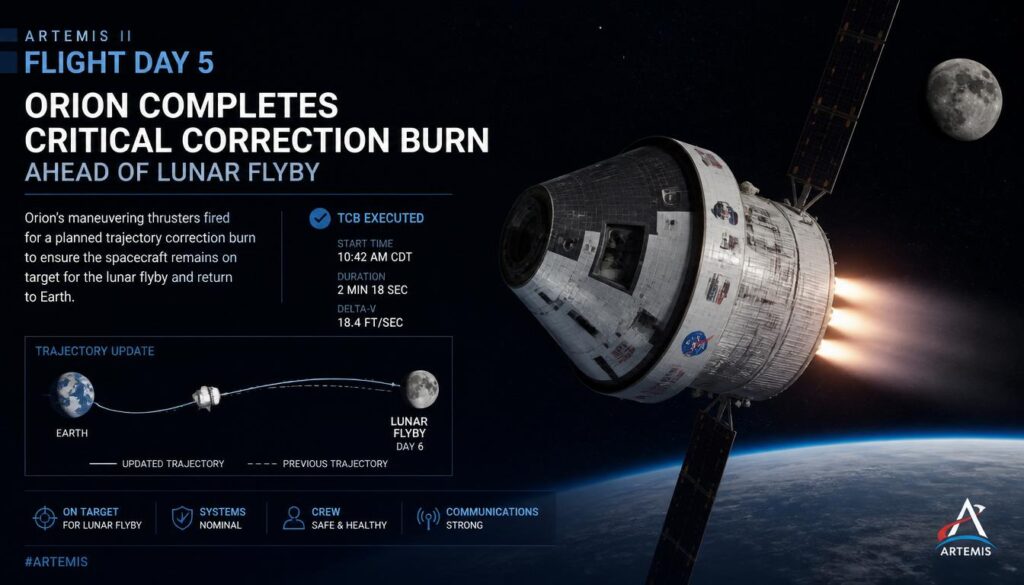
Artemis II Lunar Flyby Updates: NASA Crew Makes History Around the Moon in a Remarkable Milestone in 2026

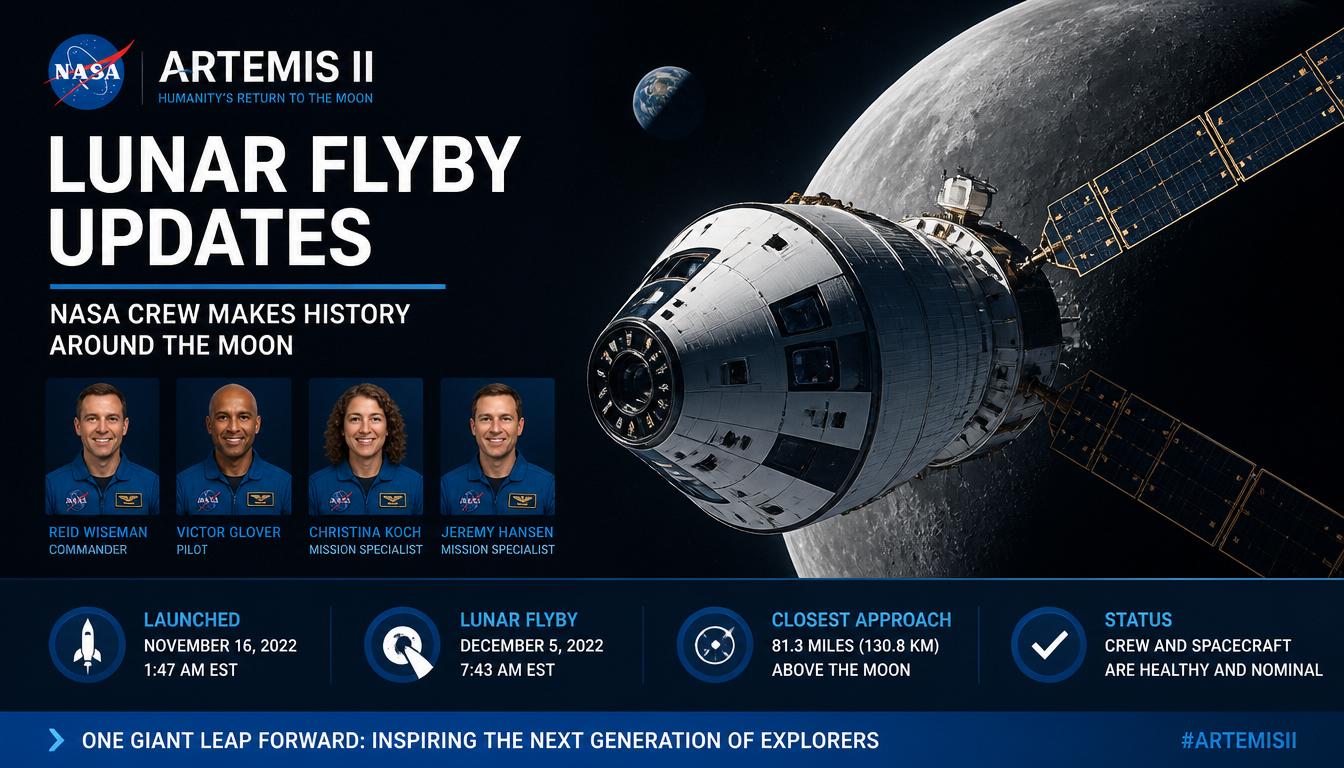
Artemis II Lunar Flyby Updates: NASA Crew Makes History Around the Moon in a Remarkable Milestone in 2026
The historic journey of Artemis II Mission continues as NASA astronauts successfully completed one of the most exciting phases of their mission — the lunar flyby. During Flight Day 6, the Orion spacecraft traveled around the Moon, broke records for human spaceflight, observed a solar eclipse, and provided breathtaking views of Earthrise from deep space.
This mission represents humanity’s return to deep-space exploration more than 50 years after the Apollo era. Millions around the world watched as the Artemis II crew moved farther from Earth than any humans in history.
Artemis II Crew Begins Historic Lunar Observation
The lunar observation period officially began when the Orion spacecraft moved close enough to the Moon for astronauts to study the surface in detail. NASA planned this observation phase to last nearly seven hours.
During this time, Orion’s windows were carefully positioned toward the Moon so the astronauts could capture clear views of craters, mountains, and geological formations. Scientists on Earth guided the crew by providing a list of important lunar targets to observe.
The observations are important because they help researchers understand the Moon’s structure, mineral composition, and geological history. These findings will support future Artemis missions that aim to land astronauts on the Moon again.
NASA Scientists Guide the Crew During Lunar Flyby
Before the observation period began, NASA’s lunar science team briefed the astronauts about their scientific objectives.
One of the primary targets was the massive Orientale Basin, a huge crater nearly 600 miles wide. Scientists believe this ancient impact basin formed around 3.8 billion years ago after a giant object struck the Moon.
Astronauts also studied the Hertzsprung Basin, another large crater located on the Moon’s far side. Unlike Orientale, this crater has been heavily damaged by later impacts over billions of years.
By comparing these lunar formations, scientists can better understand how the Moon’s surface changes over time.
Artemis II Breaks the Record for Farthest Human Spaceflight
One of the biggest moments of the mission came when the Artemis II crew officially became the farthest-traveling humans in history.
The previous record was held by the Apollo 13 astronauts in 1970, who traveled 248,655 miles away from Earth. Artemis II surpassed that record by reaching approximately 252,756 miles from Earth.
This milestone highlights the incredible advancements in modern space technology and spacecraft engineering. The crew celebrated the achievement while honoring the Apollo astronauts whose missions laid the foundation for today’s exploration.
Jeremy Hansen described the achievement as a challenge for future generations to continue pushing farther into space.
Orion Reaches Closest Distance to the Moon
As the mission progressed, Orion made its closest approach to the lunar surface at around 4,067 miles above the Moon.
At that point, the spacecraft was traveling at incredible speed relative to Earth — over 60,000 miles per hour. However, relative to the Moon, Orion moved much slower because it had entered the Moon’s gravitational influence.
This close approach allowed astronauts to study lunar features in remarkable detail. The crew observed different colors and textures on the Moon’s surface, which may reveal important clues about minerals and the age of certain regions.
Scientists in Mission Control continuously updated observation plans based on the astronauts’ discoveries and feedback.
Earthset and Earthrise Create Stunning Views from Space
One of the most emotional moments of the mission occurred when the crew witnessed an “Earthset.”
From Orion’s perspective, Earth slowly disappeared behind the Moon as the spacecraft moved across the lunar far side. Roughly 40 minutes later, the astronauts experienced an “Earthrise” as the blue planet reappeared above the lunar horizon.
These breathtaking views reminded many people of the famous Earthrise photographs captured during the Apollo missions.
The Earthrise event symbolized humanity’s connection to Earth while exploring deep space.
Communication Blackout Behind the Moon
As Orion passed behind the Moon, the spacecraft entered a planned communications blackout.
For approximately 40 minutes, the Moon blocked radio signals between Orion and NASA’s Deep Space Network. During this period, Mission Control could not communicate with the astronauts.
Similar blackouts occurred during the Apollo missions and the uncrewed Artemis I mission. Although expected, these moments remain tense because teams on Earth must wait for Orion to reappear and restore communications.
Before the signal was lost, Victor Glover sent an emotional message to Earth, expressing love and appreciation to people around the world.
When Orion emerged from behind the Moon, communications were successfully restored.
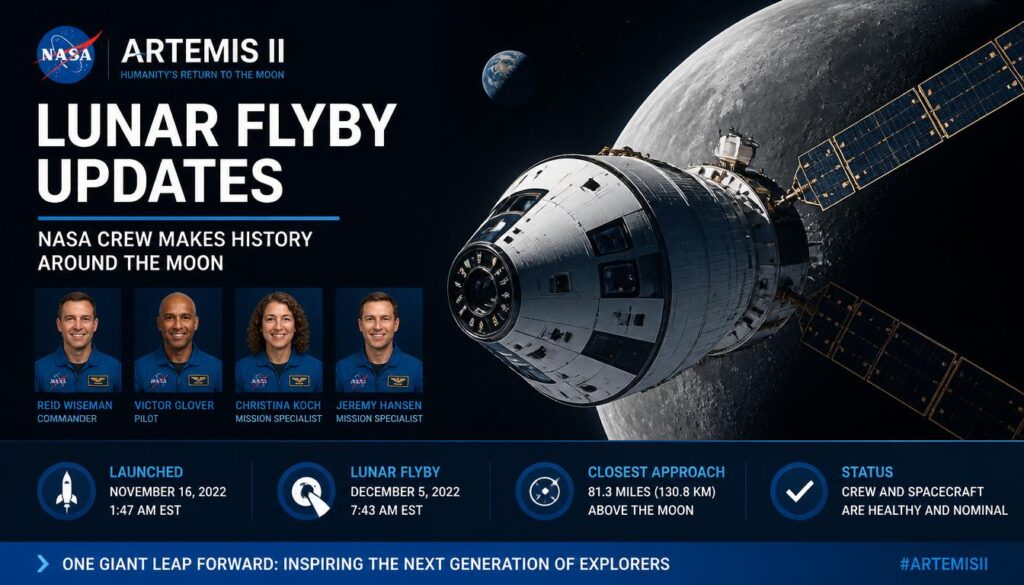
Artemis II Crew Observes a Solar Eclipse from Deep Space
Another extraordinary moment took place when Orion entered a solar eclipse.
As the Moon moved directly between Orion and the Sun, astronauts watched the Sun disappear behind the lunar surface. The eclipse lasted nearly one hour.
During this event, the crew studied the solar corona — the outer atmosphere of the Sun. Scientists are interested in the corona because it plays a major role in solar storms and space weather that can affect satellites, astronauts, and communications systems.
Astronauts also searched for flashes of light caused by meteoroids striking the Moon’s surface. These impacts may help scientists understand the dangers future lunar astronauts could face.
Very few humans in history have ever witnessed a solar eclipse from deep space, making this one of the mission’s most unique experiences.
Crew Suggests New Names for Lunar Craters
During the flyby, astronauts identified two unnamed lunar craters and proposed new names for them.
One crater was suggested to be named “Integrity” after the Orion spacecraft and the mission itself.
Another crater was proposed to be called “Carroll” in memory of Carroll Taylor Wiseman, the late wife of NASA astronaut Reid Wiseman.
These names will later be submitted to the International Astronomical Union, the group responsible for officially naming celestial features.
NASA Broadcasts the Lunar Flyby Worldwide
NASA provided live coverage of the Artemis II flyby through multiple streaming platforms, allowing millions of viewers to follow the mission in real time.
Cameras mounted on Orion’s solar arrays delivered live views of the Moon, Earthrise, and deep space. The mission was streamed across NASA+, YouTube, Amazon Prime, Hulu, Apple TV, Netflix, HBO Max, and Roku.
The global livestream brought audiences closer to the mission and inspired renewed excitement for space exploration.
Artemis II Begins the Journey Back to Earth
After completing the lunar observation period, the crew officially started its return trip to Earth.
On April 7, Orion is expected to exit the Moon’s sphere of influence at a distance of more than 41,000 miles from the Moon.
The return journey is another critical phase of the mission because NASA will continue testing spacecraft systems, astronaut safety procedures, and deep-space operations.
Every successful stage of Artemis II helps prepare for future Moon landings and eventual human missions to Mars.
Why Artemis II Is Important for the Future
The Artemis II mission is more than a simple Moon flyby. It is a major step toward the future of human exploration beyond Earth.
NASA is using the mission to test:
- Deep-space travel systems
- Crew safety technologies
- Navigation capabilities
- Radiation protection
- Long-duration mission operations
The mission also strengthens international cooperation, as Canadian astronaut Jeremy Hansen became part of one of humanity’s most important modern space missions.
Artemis II is helping create the foundation for permanent lunar exploration and future journeys to Mars.
FAQs About Artemis II Lunar Flyby
What is Artemis II?
NASA Artemis II is the first crewed mission of NASA’s Artemis program designed to send astronauts around the Moon aboard the Orion spacecraft.
What distance did Artemis II cover from Earth?
The mission reached approximately 252,756 miles from Earth, setting a new record for the farthest human spaceflight.
What is Orion spacecraft?
Orion Spacecraft Orion is NASA’s advanced spacecraft developed for human missions beyond low Earth orbit.
Why did communications stop behind the Moon?
The Moon blocked radio signals between Orion and Earth, causing a planned communication blackout for about 40 minutes.
What did astronauts study during the flyby?
The crew studied lunar craters, geological formations, the solar corona, and meteoroid impacts on the Moon.
What is Earthrise?
Earthrise occurs when Earth appears above the Moon’s horizon as seen from space.
Why is the solar eclipse observation important?
The eclipse allowed astronauts to study the Sun’s corona and observe conditions in deep space.
Will Artemis II land astronauts on the Moon?
No, Artemis II is only a lunar flyby mission. Future Artemis missions are expected to include Moon landings.
Conclusion
The Artemis II lunar flyby has become one of the most important achievements in modern space exploration. From record-breaking distances to stunning Earthrise views and deep scientific observations, the mission is proving humanity’s readiness to explore farther into space.
As Orion begins its journey home, Artemis II continues to inspire millions and pave the way for future missions to the Moon and Mars.