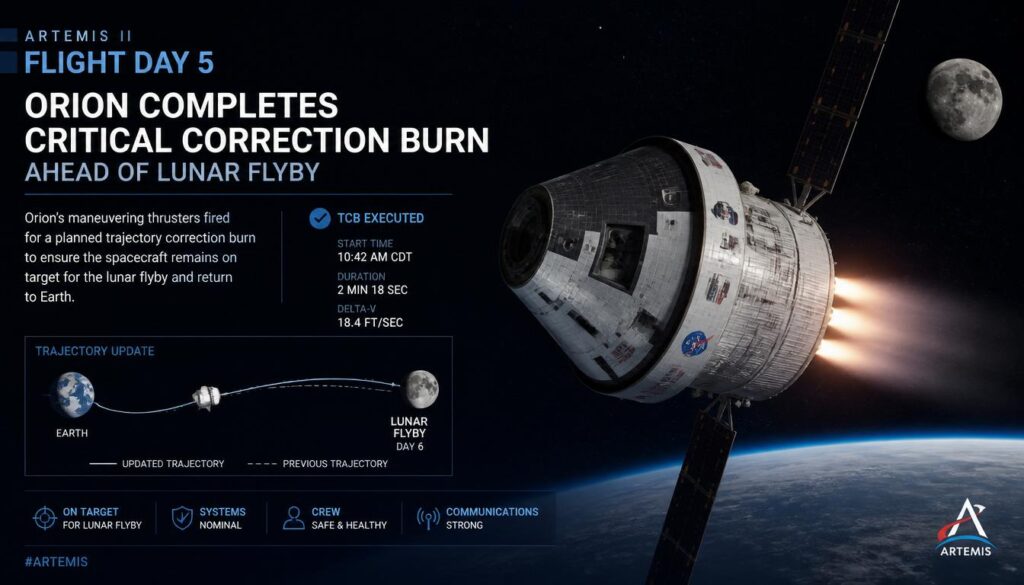
Artemis II Flight Day 6: Historic Lunar Flyby Brings Humans Closer to the Moon Again in a Remarkable Achievement

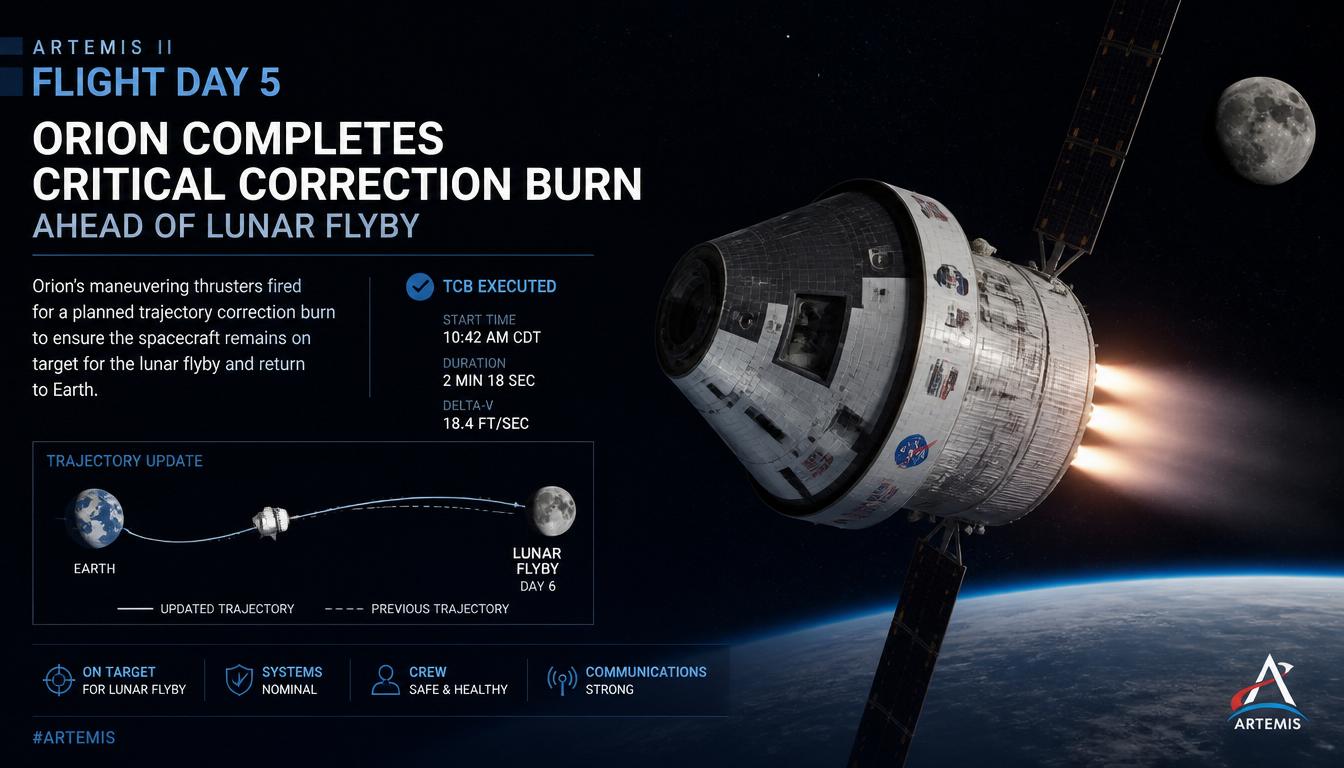
Artemis II Flight Day 6: Historic Lunar Flyby Brings Humans Closer to the Moon Again in a Remarkable Achievement
Humanity is once again making history in deep space as the crew of Artemis II Mission prepares for one of the most important moments of their journey — the lunar flyby. On Flight Day 6, the astronauts aboard the Orion spacecraft are set to travel around the far side of the Moon before beginning their return journey to Earth.
This mission marks the first time humans have traveled this close to the Moon since the Apollo 17 mission in 1972. Millions of people around the world are watching as NASA pushes the boundaries of space exploration and prepares for future missions to Mars.
Artemis II enters the region where the Moon’s gravity dominates.
During the final hours of Flight Day 5, the Orion spacecraft officially entered the Moon’s sphere of influence. This important milestone happened at 12:37 a.m. EDT on April 6, 2026. At that moment, the Moon’s gravity became stronger than Earth’s pull on the spacecraft.
The crew celebrated the achievement after taking breathtaking photographs of the Moon through Orion’s windows. Mission Specialist Christina Koch shared her excitement by saying the spacecraft was now “falling to the Moon rather than rising away from Earth.”
This transition represents a major moment in space travel because it confirms the spacecraft is successfully navigating deep space using precise orbital mechanics.
Meet the Artemis II Crew
The Artemis II mission includes four highly trained astronauts representing both the United States and Canada. The crew members are:
- Reid Wiseman
- Victor Glover
- Christina Koch
- Jeremy Hansen
Together, these astronauts are carrying out one of the most ambitious crewed missions of modern space exploration. Their work will help NASA collect valuable data for future Moon landings and eventually human missions to Mars.
A Special Wake-Up Message from Apollo Legend Jim Lovell
The astronauts began Flight Day 6 with music and a heartfelt message from legendary Apollo astronaut Jim Lovell, who recorded the message before his passing in 2025.
Lovell welcomed the crew to his “old neighborhood,” referring to the Moon missions of the Apollo era. He reminded the astronauts that Apollo 8 gave humanity its first close-up view of the Moon and inspired people across the world.
His message connected the historic Apollo missions with NASA’s new Artemis program, symbolizing how one generation of explorers is passing the torch to another.
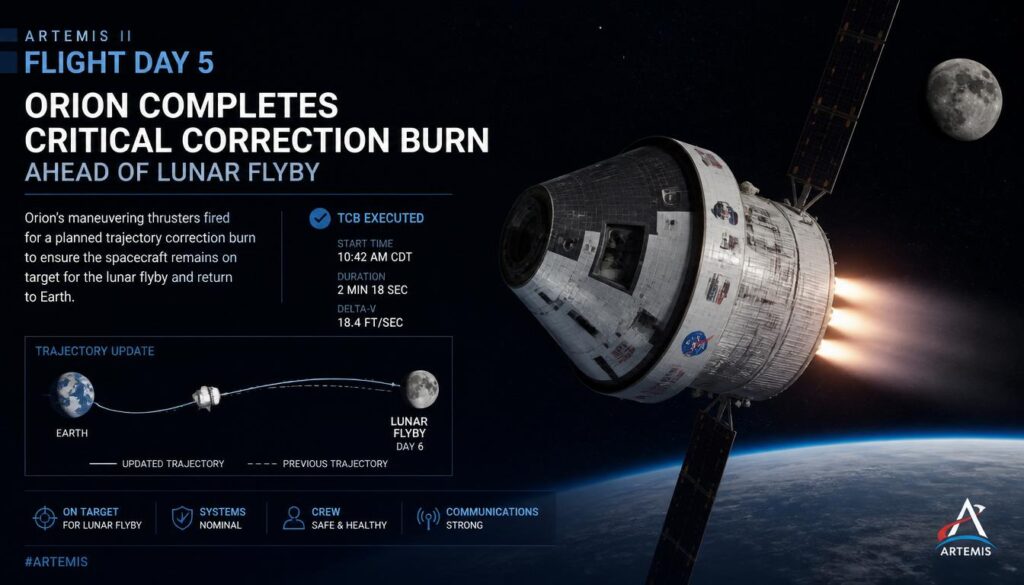
Artemis II Breaks Human Distance Record
One of the most exciting achievements of the mission will occur when Orion surpasses the record for the farthest distance humans have ever traveled from Earth.
Previously, the record belonged to the crew of Apollo 13, who traveled 248,655 miles from Earth in 1970. Artemis II is expected to reach approximately 252,760 miles away from Earth, creating a new historic milestone in human spaceflight.
This achievement demonstrates how far modern space technology has advanced since the Apollo era.
Lunar Flyby and Surface Observations
The lunar flyby is expected to last around seven hours. During this time, the crew will carefully observe the Moon’s surface and study its geological features.
Astronauts will have a unique opportunity to view craters, mountains, valleys, and other lunar formations from a close distance. These observations will help scientists better understand the Moon’s environment and prepare for future Artemis missions that aim to land humans on the lunar surface again.
NASA cameras attached to Orion’s solar arrays will also provide live views of the Moon for viewers on Earth.
Communication Blackout Behind the Moon
When Orion moves to the far side of the Moon, the spacecraft will briefly be unable to communicate with Mission Control. This planned blackout is expected to last around 40 minutes.
The loss of signal happens because the Moon blocks radio communication between the spacecraft and NASA’s Deep Space Network.
Although communication blackouts are normal during lunar missions, they remain tense moments because Mission Control cannot contact the astronauts during this period.
Shortly after the blackout begins, Orion will make its closest approach to the Moon at just 4,070 miles above the lunar surface.
Witnessing a Solar Eclipse from Space
Another incredible moment during Flight Day 6 will be a rare solar eclipse viewed directly from space.
As Orion, the Moon, and the Sun align, the astronauts will see the Sun disappear behind the Moon for nearly one hour. During this event, the crew will study the Sun’s outer atmosphere, known as the solar corona.
Scientists are especially interested in the corona because it plays a major role in solar storms and space weather, which can affect satellites and future astronauts traveling through deep space.
Seeing a solar eclipse from the Moon’s vicinity is an extraordinary experience very few humans have ever witnessed.
Key Events During Artemis II Flight Day 6
Several important moments are scheduled throughout the lunar flyby mission:
Science Briefing
NASA scientists will brief the crew about the scientific objectives and observations planned during the flyby.
Breaking the Distance Record
The astronauts are expected to officially become the farthest-traveling humans in history.
Lunar Observation Period
The crew will spend hours studying the Moon’s surface and capturing images.
Earthset and Earthrise
Astronauts will witness Earth disappearing behind the Moon and later reappearing — a stunning visual event similar to sunrise and sunset.
Closest Approach to the Moon
Orion will pass just over 4,000 miles above the lunar surface.
Solar Eclipse Observation
The crew will observe and study a rare eclipse from space.
Return Journey Begins
After completing the flyby, Orion will continue its path back toward Earth.
Why Artemis II Is Important for Future Space Exploration
The Artemis II mission is more than just a journey around the Moon. It is a critical test for NASA’s future plans to establish a long-term human presence on the Moon and eventually send astronauts to Mars.
The mission is testing:
- Deep-space navigation systems
- Human survival in deep space
- Communication technologies
- Radiation protection
- Spacecraft performance
Every success during Artemis II brings humanity one step closer to future lunar bases and interplanetary travel.
FAQs About Artemis II Flight Day 6
What is Artemis II?
NASA Artemis II is a crewed mission designed to send astronauts around the Moon aboard the Orion spacecraft. It is part of NASA’s Artemis program focused on returning humans to the Moon.
Who are the astronauts on Artemis II?
The crew includes Reid Wiseman, Victor Glover, Christina Koch, and Jeremy Hansen from Canada.
Why is the lunar flyby important?
The flyby allows astronauts to study the Moon closely and test spacecraft systems before future Moon landing missions.
What will be the maximum distance of Artemis II from Earth?
The mission is expected to reach approximately 252,760 miles from Earth, setting a new human distance record.
What happens during the communication blackout?
When Orion moves behind the Moon, radio signals cannot reach Earth, causing a temporary communication loss with Mission Control.
What is Orion?
Orion Spacecraft Orion is NASA’s advanced spacecraft designed for long-distance human space missions beyond Earth orbit.
Will Artemis II land on the Moon?
No, Artemis II will orbit and fly around the Moon but will not land. Future Artemis missions are expected to include lunar landings.
Why is the solar eclipse observation important?
The eclipse allows astronauts to study the Sun’s corona, which helps scientists better understand solar activity and space weather.
Conclusion
The Artemis II mission is opening a new chapter in human space exploration. From breaking distance records to witnessing a solar eclipse near the Moon, the mission showcases humanity’s growing ability to travel deeper into space.
As the Orion spacecraft swings around the far side of the Moon, the world watches a historic moment unfold — one that may eventually lead humans to Mars and beyond.