Artemis II Flight Day 5: Orion Completes Critical Correction Burn Ahead of Lunar Flyby

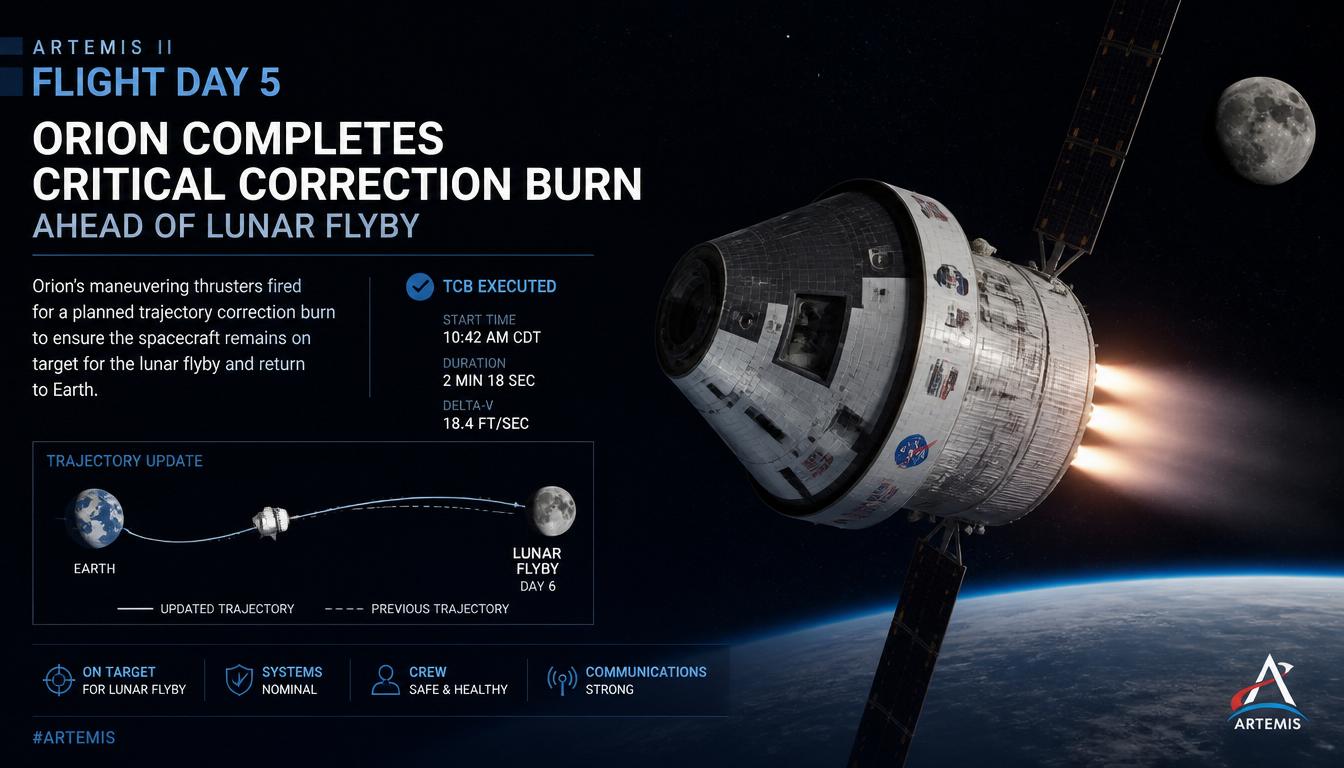
Artemis II Flight Day 5: Orion Completes Critical Correction Burn Ahead of Lunar Flyby
On Flight Day 5, the NASA Artemis II mission achieved another significant milestone when mission control teams and the astronauts on the Orion spacecraft carried out an outbound trajectory correction burn, all while continuing to prepare for the historic lunar flyby.
The successful maneuver refined Orion’s trajectory toward the Moon and helped ensure the spacecraft remains on the correct path for its close flyby around the lunar far side. Alongside navigation operations, the crew also completed important spacesuit testing and prepared to enter the Moon’s gravitational sphere of influence.
As Artemis II moves deeper into space, the mission continues demonstrating the advanced technology and teamwork required for future human exploration missions to the Moon and beyond.
Orion Continues Precise Journey Toward the Moon
NASA’s Orion spacecraft continues traveling toward the Moon with astronauts Reid Wiseman, Victor Glover, Christina Koch, and Canadian Space Agency astronaut Jeremy Hansen onboard.
During Flight Day 5, the spacecraft remained on a highly accurate trajectory as mission teams prepared for one of the most important events of the journey — the lunar flyby.
NASA released images showing Orion traveling through deep space while the spacecraft continued approaching the Moon. The mission remains one of humanity’s most ambitious modern deep-space exploration efforts.
Artemis II Completes Successful Correction Burn
One of the biggest achievements of Flight Day 5 was the successful outbound correction burn performed by Orion.
The engine burn began at approximately 11:03 p.m. EDT and lasted for around 17.5 seconds.
Although the burn itself was relatively short, it played an extremely important role in refining Orion’s flight path toward the Moon.
Trajectory correction burns are used to make precise adjustments to a spacecraft’s direction and speed during long-distance space travel. Even tiny adjustments to navigation can greatly enhance mission precision across hundreds of thousands of miles.
NASA engineers carefully monitor spacecraft positioning to ensure Orion remains perfectly aligned for its planned lunar flyby.
Why the Correction Burn Was Important
The correction burn helped fine-tune Orion’s path before the spacecraft entered the Moon’s gravitational influence.
Deep-space missions require extremely precise navigation because tiny flight path differences can become much larger over time.
NASA had canceled earlier planned correction burns during the mission because Orion’s navigation systems were already performing very accurately. However, the Flight Day 5 burn provided an additional adjustment to optimize the spacecraft’s approach toward the Moon.
These maneuvers are essential for ensuring astronaut safety and mission success during lunar and future Mars missions.
Orion Crew Completes Spacesuit Demonstration
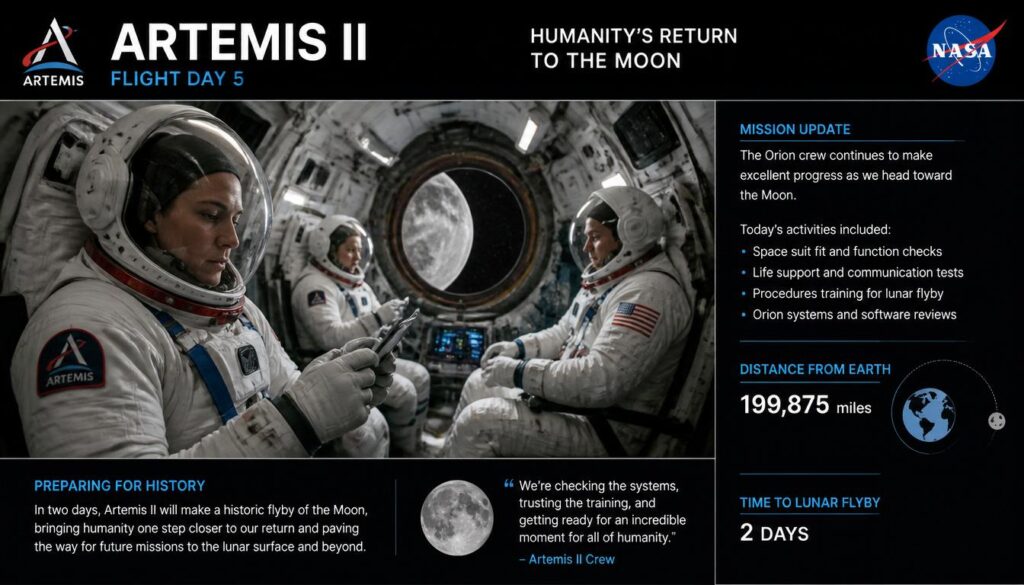
Earlier in the workday, the Artemis II astronauts finished one of the mission’s key test tasks related to the Orion Crew Survival System (OCSS) suits.
All four crew members participated in a complete series of suit evaluations.
The testing included:
- Putting on the suits
- Pressurizing the suits
- Performing leak checks
- Simulating seat entry procedures
- Testing mobility in microgravity
- Evaluating eating and drinking capabilities while suited
NASA uses these demonstrations to evaluate how the suits perform during extended deep-space operations.
What Are Orion Crew Survival System Suits?
The Orion Crew Survival System suits are specially designed safety suits created for Artemis missions.
These advanced suits help protect astronauts during:
- Launch and reentry
- Emergency cabin depressurization
- Splashdown recovery operations
- Dynamic spacecraft maneuvers
The suits also provide life support, communication systems, and improved mobility compared with older astronaut suits.
NASA continues studying how astronauts interact with the suits during spaceflight to improve comfort, safety, and operational efficiency for future exploration missions.
Moon’s Gravity Begins Influencing Orion
Another major milestone during Flight Day 5 involved Orion preparing to enter the Moon’s sphere of gravitational influence.
NASA expected this event to occur at approximately 12:41 a.m. on April 6.
Once Orion enters this region, the Moon’s gravity becomes the dominant force affecting the spacecraft’s trajectory instead of Earth’s gravity.
This marks one of the most important stages of the mission because it confirms Orion is successfully approaching the Moon for its planned flyby.
Entering the lunar sphere of influence also begins the transition toward Flight Day 6 and the crew’s close journey around the far side of the Moon.
Flight Day 6 Will Feature Historic Lunar Flyby
NASA confirmed that Flight Day 6 will include the mission’s highly anticipated lunar flyby.
During this phase, Orion will travel around the far side of the Moon while astronauts perform scientific observations and photography.
The flyby will allow the crew to:
- Observe lunar craters and surface features
- Photograph the Moon
- Conduct geological studies
- Monitor spacecraft systems
- Witness Earthrise and a solar eclipse from space
The lunar flyby represents one of the most visually spectacular and scientifically important moments of the Artemis II mission.
Artemis II Set to Break Apollo 13 Distance Record
Another historic achievement expected during Flight Day 6 is Orion surpassing the Apollo 13 distance record.
NASA expects the crew will become the humans who have traveled the greatest distance from Earth in history.
The previous record was established during the Apollo 13 mission in 1970.
According to mission plans, Orion is expected to reach a maximum distance of approximately 252,757 miles from Earth.
Breaking this record demonstrates the capabilities of modern deep-space spacecraft and highlights NASA’s progress since the Apollo era.
Planned Communications Blackout Behind the Moon
As Orion travels behind the Moon during the flyby, communication with Earth will temporarily stop.
NASA expects the communications blackout to begin around 6:44 p.m. EDT and last approximately 40 minutes.
This interruption happens because the Moon blocks radio signals between Orion and Earth-based communication systems.
Similar communication blackouts occurred during Apollo missions and the uncrewed Artemis I mission.
Although temporary, the blackout remains one of the most dramatic moments of the mission because astronauts will operate independently while hidden behind the Moon.
Earthrise and Solar Eclipse to Be Seen from Orion
The Artemis II crew will also witness incredible celestial events during the flyby.
At approximately 7:25 p.m., astronauts are expected to observe “Earthrise” as Earth reappears above the lunar horizon after Orion emerges from behind the Moon.
Later, astronauts will experience a solar eclipse from deep space as the Moon blocks the Sun from Orion’s perspective.
The eclipse is expected to last from approximately 8:35 p.m. to 9:32 p.m.
During this time, astronauts may observe the solar corona glowing around the Moon’s edge.
These extraordinary views will likely become some of the most iconic moments in modern space exploration.
Orion Crew Maintains Daily Mission Schedule
Despite the mission’s historic milestones, astronauts aboard Orion continue following structured daily schedules.
The crew balances:
- Spacecraft operations
- Scientific activities
- Exercise routines
- Communication tasks
- Meal periods
- Sleep schedules
NASA carefully manages astronaut workloads to maintain physical health, mental focus, and operational readiness during deep-space missions.
The Artemis II crew planned to begin their sleep period around 2:20 a.m. before starting Flight Day 6 later in the day.
Artemis II Prepares NASA for Future Moon Missions
Although Artemis II will not land astronauts on the Moon, the mission is critical for future Artemis exploration goals.
NASA is using Artemis II to test:
- Orion spacecraft systems
- Crew operations
- Navigation capabilities
- Spacesuit performance
- Deep-space communication systems
- Human performance during lunar missions
The information gathered during Artemis II will directly support future lunar landing missions such as Artemis III.
NASA also plans to apply lessons learned during Artemis II to eventual human missions to Mars.
Public Excitement Around Artemis II Continues Growing
Millions of people worldwide continue following the Artemis II mission through live broadcasts, social media updates, and NASA coverage.
The mission represents humanity’s return to deep-space human exploration after decades without crewed lunar missions.
International cooperation between NASA and the Canadian Space Agency also highlights the global importance of space exploration.
As Orion approaches its lunar flyby, public excitement continues increasing around the mission’s historic achievements.
Conclusion
Flight Day 5 of the Artemis II mission demonstrated the precision, technology, and teamwork required for successful deep-space travel. From completing the critical correction burn to testing survival suits and preparing for the lunar flyby, the Orion crew continues achieving major milestones on humanity’s journey back to the Moon.
As Flight Day 6 approaches, Artemis II stands ready to deliver one of the most exciting moments in modern space exploration history.
FAQs
What happened during Artemis II Flight Day 5?
The crew completed a trajectory correction burn, tested Orion survival suits, and prepared for the lunar flyby.
What is a trajectory correction burn?
It is a small engine firing used to refine a spacecraft’s flight path during space missions.
Why was the correction burn important?
The maneuver helped fine-tune Orion’s trajectory before the spacecraft reached the Moon.
What are Orion Crew Survival System suits?
They are advanced astronaut safety suits designed for deep-space Artemis missions.
What happens when Orion enters the Moon’s sphere of influence?
The Moon’s gravity becomes the primary force controlling the spacecraft’s trajectory.
Will Artemis II land astronauts on the Moon?
No, Artemis II is a lunar flyby mission and will not include a Moon landing.
What historic record will Artemis II break?
The mission is expected to surpass Apollo 13’s record for the farthest humans have traveled from Earth.
Why will communication stop behind the Moon?
The Moon blocks radio signals between Orion and Earth, causing a temporary communications blackout.
What is Earthrise during Artemis II?
Earthrise occurs when Earth becomes visible again above the lunar horizon after Orion passes behind the Moon.
Why is Artemis II important for future missions?
The mission helps NASA test technologies and astronaut operations needed for future Moon landings and Mars missions.
read another article
,Flyby