Artemis II Flight Day 5: Orion Crew Tests Space Suits and Prepares for Historic Successful Lunar Flyby

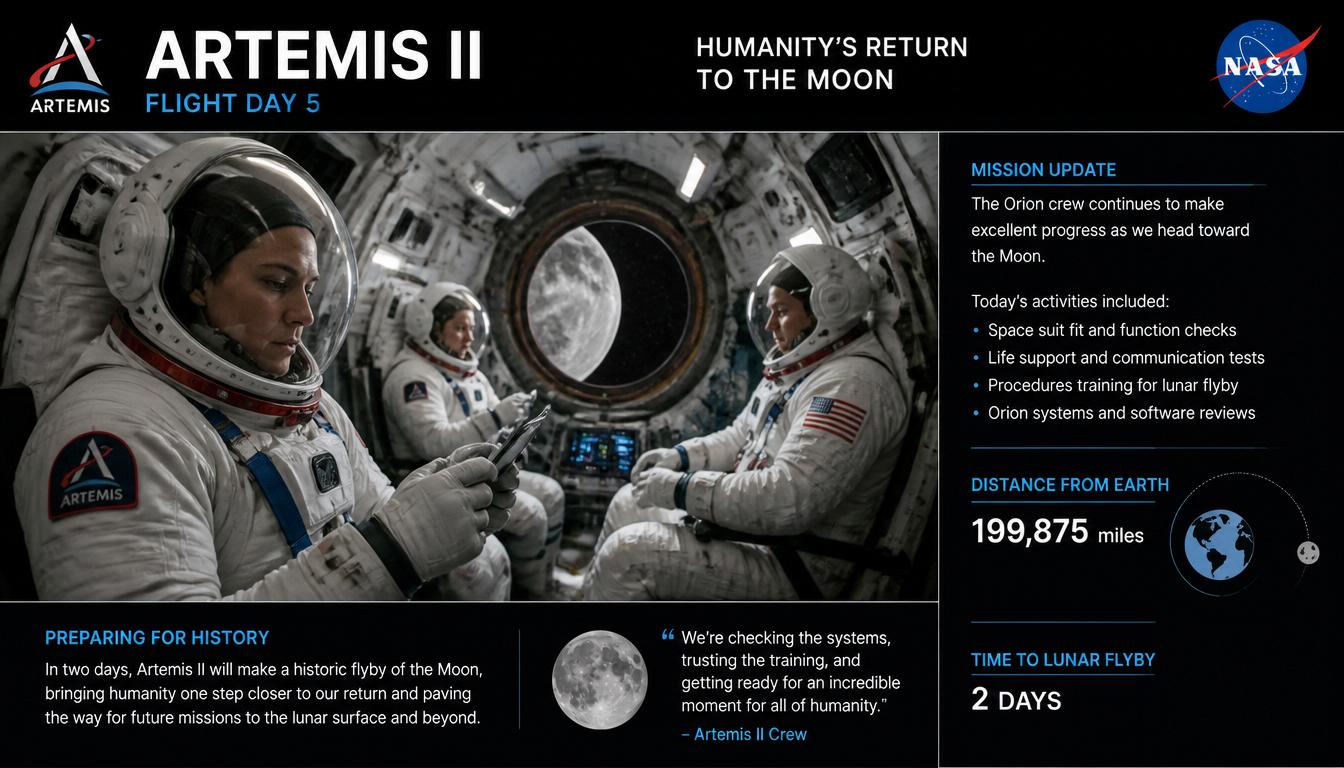
Artemis II Flight Day 5: Orion Crew Tests Space Suits and Prepares for Historic Successful Lunar Flyby
The NASA Artemis II mission continued making historic progress during Flight Day 5 as astronauts aboard the Orion spacecraft carried out critical space suit demonstrations and finalized preparations for their upcoming lunar flyby.
Traveling farther from Earth than most human missions in history, the Artemis II crew spent the day testing safety systems, reviewing lunar science targets, and preparing Orion for one of the most important phases of the mission. As the spacecraft moved closer to the Moon, excitement continued building around humanity’s return to deep-space exploration.
Orion Continues Journey Toward the Moon
The Orion spacecraft continues its smooth flight path toward the Moon while carrying NASA astronauts Reid Wiseman, Victor Glover, Christina Koch, and Canadian Space Agency astronaut Jeremy Hansen.
During Flight Day 5, the astronauts observed Earth growing smaller through Orion’s windows as the spacecraft traveled deeper into space. NASA released a breathtaking image captured by one of the crew members showing Earth illuminated against the darkness of space while Orion approached the Moon.
The mission represents one of NASA’s most important modern exploration efforts and serves as a major step toward future lunar landings under the Artemis program.
Artemis II Crew Continues Space Suit Demonstrations
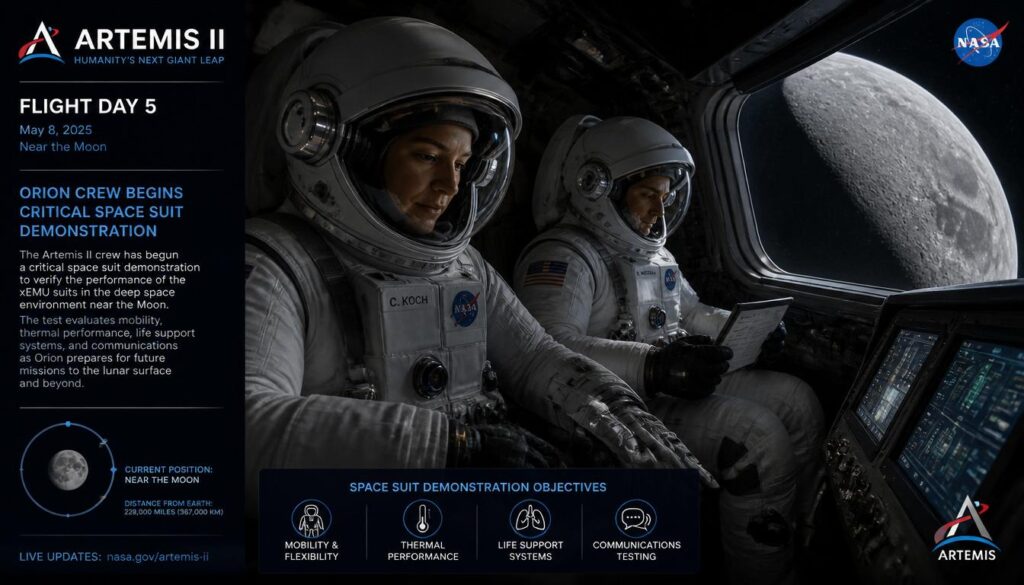
One of the primary activities during Flight Day 5 involved testing the Orion Crew Survival System suits.
The astronauts conducted detailed evaluations of the specialized suits by performing several operational procedures, including:
- Leak checks
- Suit pressurization tests
- Simulated seat entry
- Mobility testing
- Eating and drinking evaluations while suited
NASA designed these suits to protect astronauts during critical phases of flight, including launch, reentry, and emergency situations.
The demonstration helps engineers study how the suits perform during long periods in microgravity and deep-space conditions.
Why Orion Crew Survival System Suits Are Important
The Orion Crew Survival System suits play a major role in astronaut safety during Artemis missions.
These advanced suits provide:
- Emergency life support
- Protection during cabin depressurization
- Thermal regulation
- Communication support
- Survival assistance after splashdown
Unlike older spacesuits used during the Apollo era, the new Orion suits include improved flexibility, mobility, and advanced technology that supports astronauts during long-duration missions.
NASA is carefully studying how astronauts move and operate while wearing the suits in space to improve future mission safety and efficiency.
Orion Approaches the Moon’s Sphere of Influence
Another major milestone during Flight Day 5 involved Orion approaching the Moon’s gravitational sphere of influence.
NASA expected Orion to officially enter the lunar gravitational region shortly after midnight on April 6. Once inside this area, the Moon’s gravity begins influencing the spacecraft more strongly than Earth’s gravity.
This milestone confirms that Orion is successfully approaching the Moon for its planned flyby.
Entering the lunar sphere of influence is one of the most important navigation events during the mission.
Final Outbound Trajectory Correction Burn Scheduled
Mission teams also prepared for the spacecraft’s final outbound trajectory correction burn.
The maneuver was scheduled for approximately 11:03 p.m. EDT and would help refine Orion’s flight path before the lunar flyby.
Interestingly, earlier trajectory correction burns during the mission had been canceled because Orion’s navigation remained extremely accurate.
Trajectory correction burns are important because even small adjustments can significantly improve spacecraft positioning over long distances in deep space.
During the procedure, Christina Koch and Jeremy Hansen reviewed spacecraft configuration and navigation procedures to ensure the burn would be completed successfully.
NASA Sends Final Lunar Science Targets
Mission control also sent the Artemis II crew their final lunar science observation targets.
Astronauts will use these targets during the six-hour lunar flyby to photograph and study important surface features on the Moon.
The lunar science team selected around 30 observation targets for the crew to analyze during the flyby.
These scientific observations will help researchers better understand the Moon’s geological history and surface evolution.
Orientale Basin Becomes a Major Observation Target
One of the most important lunar targets for the Artemis II crew is the Orientale Basin.
This enormous impact crater measures nearly 600 miles across and stretches between the Moon’s near side and far side.
Scientists consider Orientale one of the best-preserved examples of a multi-ring impact basin anywhere in the solar system.
The crater formed approximately 3.8 billion years ago after a massive object collided with the Moon.
Astronauts will study the basin’s rings, terrain, and geological features from multiple angles during the flyby.
The observations could provide valuable insight into planetary impacts throughout the solar system.
Hertzsprung Basin Offers Geological Comparison
Another important target on the crew’s observation list is the Hertzsprung Basin.
Located on the Moon’s far side, Hertzsprung is an older impact basin that has experienced significant erosion and damage from later impacts.
NASA scientists want astronauts to compare Hertzsprung with the younger and better-preserved Orientale Basin.
By studying the differences between the two craters, researchers can learn how lunar surface features change over billions of years.
This comparison will improve understanding of planetary geology across rocky worlds in the solar system.
Lunar Flyby Timeline Includes Historic Moments
NASA released a detailed timeline for the Artemis II lunar flyby, which includes several historic events.
Some of the key moments include:
- Orion entering the Moon’s gravitational sphere of influence
- Beginning lunar science observations
- Breaking the Apollo 13 distance record
- Passing behind the Moon
- Experiencing a communications blackout
- Witnessing Earthset and Earthrise
- Observing a solar eclipse from space
These events will make Artemis II one of the most visually and scientifically exciting crewed space missions in modern history.
Artemis II Will Break Apollo 13 Distance Record
One of the most historic achievements expected during the mission is Orion surpassing the Apollo 13 distance record.
NASA predicts the crew will travel farther from Earth than any humans in history, reaching approximately 252,760 miles away from the planet.
For comparison, Apollo 13 traveled around 248,655 miles from Earth during its emergency mission in 1970.
Breaking this record demonstrates the capabilities of modern spacecraft technology and highlights NASA’s progress in deep-space exploration.
Planned Communications Blackout Behind the Moon
During the lunar flyby, Orion will temporarily lose communication with Earth while passing behind the Moon.
This planned blackout is expected to last around 40 minutes because the Moon will block radio signals between Orion and NASA’s Deep Space Network.
Similar communication blackouts occurred during Apollo missions and the uncrewed Artemis I mission.
Although communication temporarily stops, NASA carefully plans for these periods and expects systems to operate normally throughout the blackout.
Once Orion reappears from behind the Moon, communication with Mission Control will quickly resume.
Earthset and Earthrise to Be Seen from Orion
The Artemis II astronauts will also witness extraordinary views of Earth during the flyby.
At one point, the crew will see “Earthset,” where Earth slowly disappears behind the Moon from Orion’s perspective.
Later, astronauts will observe “Earthrise,” when Earth reappears above the lunar horizon.
These breathtaking views are expected to become some of the most iconic moments of the mission.
Experiences like these continue inspiring people around the world and highlight the beauty of human space exploration.
Solar Eclipse Observation from Deep Space
Another major event during the flyby will be a solar eclipse observed from Orion.
As the Moon moves between Orion and the Sun, astronauts will watch the Sun disappear behind the lunar surface for nearly an hour.
During the eclipse, the crew will observe the solar corona — the Sun’s outer atmosphere — glowing around the Moon’s edge.
Scientists hope these observations will provide additional insight into solar activity and deep-space lighting conditions.
Artemis II Supports Future Human Exploration
Although Artemis II will not land astronauts on the Moon, the mission is extremely important for future lunar exploration.
NASA is using the mission to test:
- Orion spacecraft systems
- Astronaut operations
- Navigation technologies
- Space suit performance
- Deep-space communication systems
- Scientific observation procedures
The knowledge gained during Artemis II will directly support future missions, including Artemis III, which aims to land astronauts on the lunar surface.
NASA also plans to use Artemis experience to prepare for future missions to Mars.
Conclusion
Flight Day 5 of the Artemis II mission demonstrated the advanced technology, preparation, and teamwork required for successful deep-space exploration. From testing survival suits and refining Orion’s trajectory to preparing for lunar science operations, the crew continues making history on humanity’s return journey to the Moon.
As the lunar flyby approaches, Artemis II remains one of NASA’s most exciting and important missions of the modern space era.
FAQs
What happened during Artemis II Flight Day 5?
The crew tested Orion survival suits, prepared for the lunar flyby, reviewed science targets, and readied a trajectory correction burn.
What are Orion Crew Survival System suits?
These are advanced astronaut safety suits designed for launch, reentry, emergency situations, and deep-space missions.
Why is the lunar flyby important?
The flyby allows astronauts to test Orion systems and conduct scientific observations of the Moon.
What is the Orientale Basin?
Orientale Basin is a massive impact crater on the Moon used by scientists to study planetary impact formations.
What is the Hertzsprung Basin?
Hertzsprung Basin is an older lunar impact crater located on the Moon’s far side.
Why will Orion lose communication behind the Moon?
The Moon blocks radio signals between Orion and Earth, causing a planned temporary communications blackout.
What record will Artemis II break?
The mission is expected to surpass the Apollo 13 record for the farthest humans have traveled from Earth.
What are Earthset and Earthrise?
Earthset occurs when Earth disappears behind the Moon, while Earthrise happens when Earth reappears from behind the lunar horizon.
Will Artemis II land astronauts on the Moon?
No, Artemis II is a lunar flyby mission and will not include a Moon landing.
Why is Artemis II important for future Mars missions?
The mission helps NASA test deep-space technologies, astronaut systems, and spacecraft operations needed for future Mars exploration.
1 comment