Artemis II Flight Day 3: Orion Crew Prepares for Historic Successful Lunar Flyby Mission

Updated
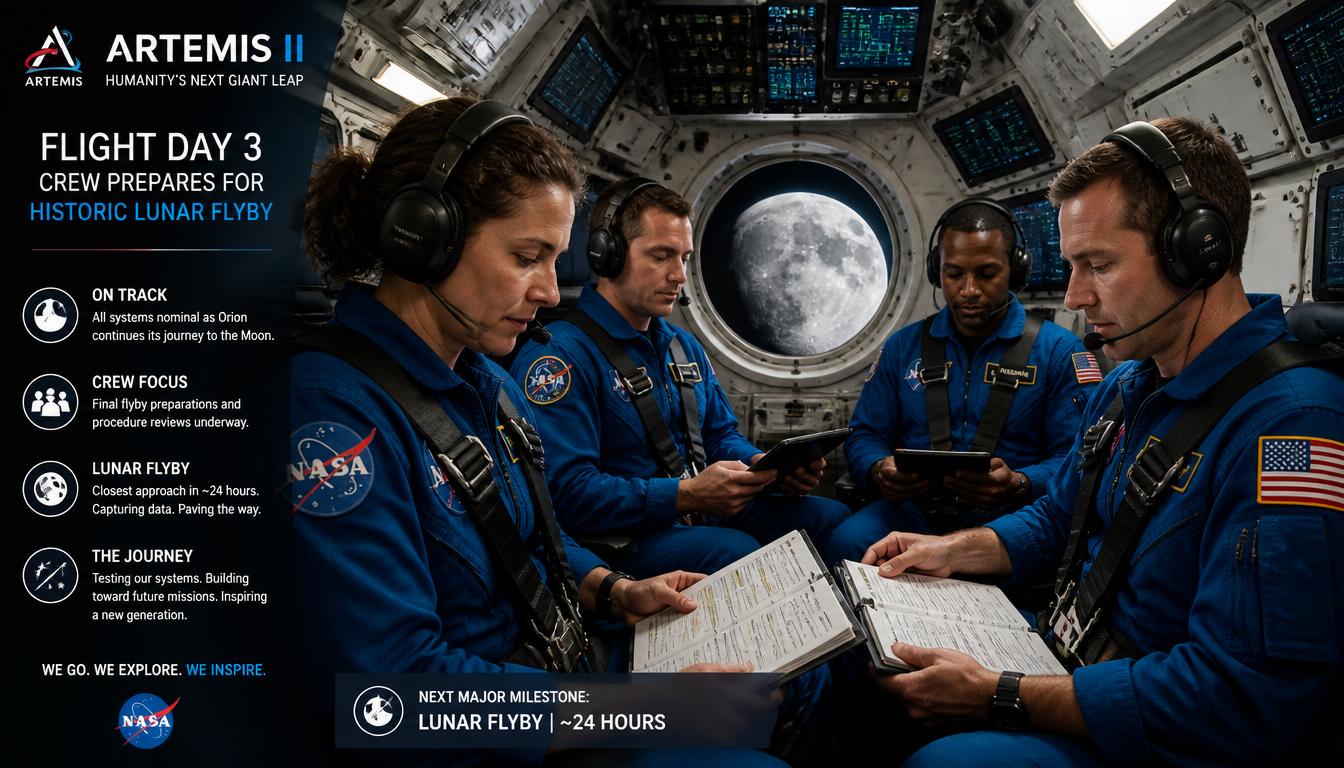
Artemis II Flight Day 3: Orion Crew Prepares for Historic Successful Lunar Flyby Mission
Artemis II Flight Day 3: Orion Crew Prepares for Historic Lunar Flyby Mission
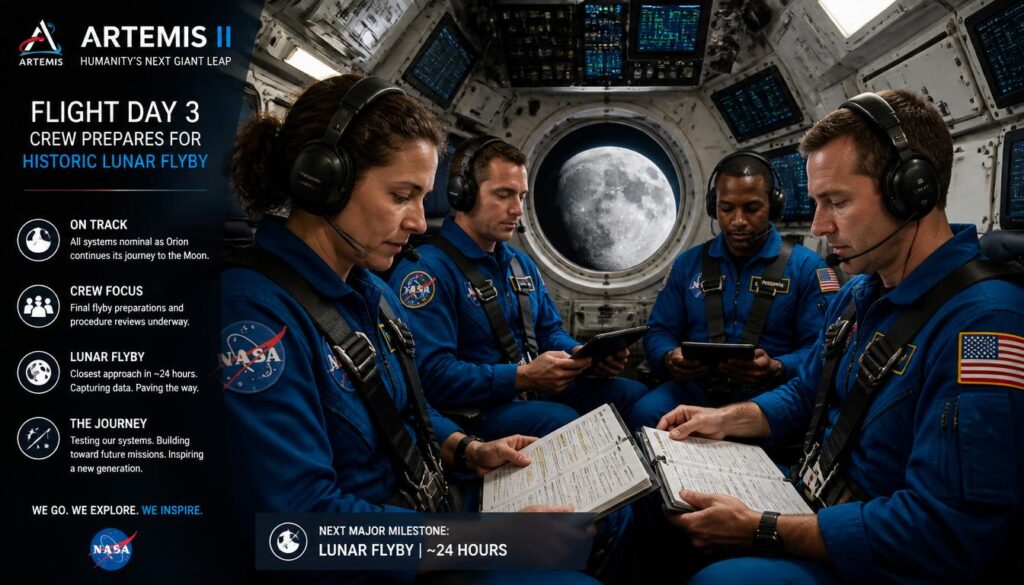
The NASA Artemis II mission continues to move closer to the Moon as astronauts aboard the Orion spacecraft complete critical preparations during Flight Day 3. The mission has now traveled more than halfway to the Moon, marking another historic moment in humanity’s return to deep space exploration.
During this phase of the journey, astronauts focused on cabin preparation, communication testing, health exercises, and emergency response training while enjoying incredible views of the Moon from inside the Orion spacecraft.
Artemis II Reaches an Important Midpoint in Space
Flight Day 3 became a memorable milestone for the Artemis II crew because the spacecraft officially crossed the halfway point on its journey toward the Moon.
As Orion traveled through deep space, the astronauts were able to look through the docking hatch and see the Moon growing larger in the distance. Christina Koch described the emotional moment by saying the crew experienced a collective feeling of joy while observing the beautiful lunar view.
Moments like these remind astronauts and mission teams why human exploration beyond Earth remains one of NASA’s greatest goals.
Orion Spacecraft Continues Smooth Journey
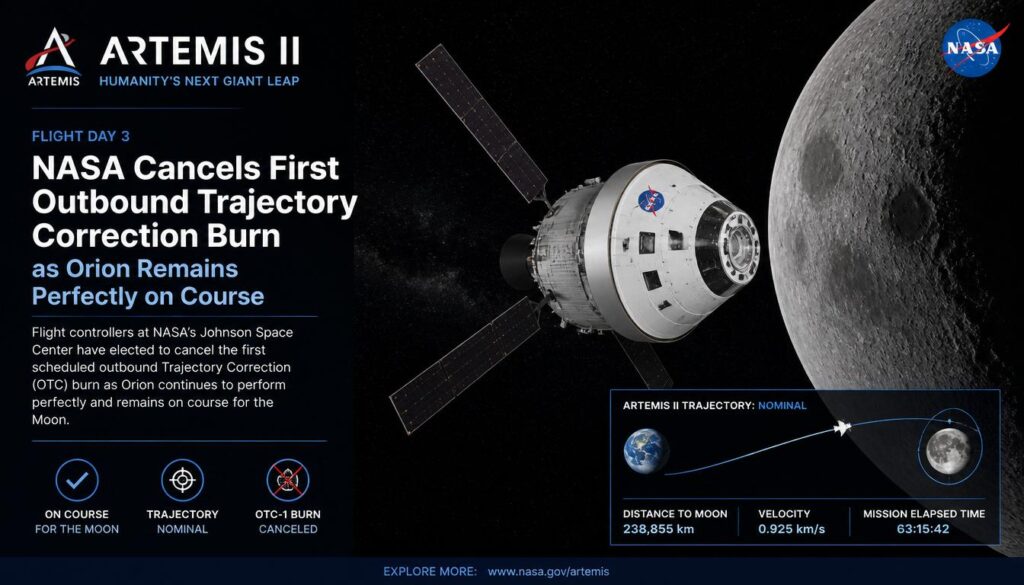
NASA originally planned an outbound trajectory correction burn during this stage of the mission. However, engineers later canceled the maneuver because Orion was already traveling accurately along its planned path.
This decision showed how precisely the spacecraft and navigation systems were operating during the mission. Rather than carrying out the burn, the astronauts turned their focus to getting the spacecraft cabin ready for the upcoming phase of observing the Moon.
The Orion spacecraft is specifically designed for deep-space travel and future human missions beyond low Earth orbit. Artemis II serves as one of the most important tests of Orion before future lunar landing missions begin.
Crew Members Work Together Inside Orion
Inside the spacecraft, astronauts Victor Glover, Jeremy Hansen, and Reid Wiseman worked closely together to organize cabin systems and equipment.
Preparing the cabin for lunar observation activities is important because the spacecraft will soon perform a flyby around the Moon. During this time, astronauts will observe lunar conditions, monitor spacecraft systems, and collect operational data for future Artemis missions.
Teamwork plays a major role during space missions. Every astronaut has specific responsibilities, and successful coordination helps ensure that all mission operations are completed safely and efficiently.
Astronauts Continue Daily Exercise Routines
Even while traveling through deep space, astronauts must continue exercising every day. Space missions expose the human body to microgravity, which can weaken muscles and bones over time.
To reduce these effects, the Artemis II crew completed scheduled physical exercise sessions during Flight Day 3. These workouts help astronauts maintain strength, improve circulation, and stay healthy throughout the mission.
NASA deliberately plans exercise routines for astronauts since staying physically fit is very important during extended space missions.
Exercise equipment aboard Orion allows astronauts to stay active even in the limited space available inside the spacecraft.
Medical Emergency Training in Deep Space
Flight Day 3 also included emergency medical response practice. NASA astronauts train extensively before launch so they can respond quickly to medical situations during space missions.
The crew reviewed procedures that could be used in case of illness, injury, or unexpected emergencies during the mission. Since astronauts are far away from Earth, they must be prepared to handle many situations independently.
Medical training is especially important for future missions to the Moon and Mars because communication delays and long travel distances make immediate Earth-based assistance impossible.
NASA uses Artemis II as an opportunity to evaluate how astronauts perform medical operations while traveling through deep space.
Testing Orion’s Communication Systems
One of the most important tasks completed during Flight Day 3 involved testing Orion’s emergency communication system.
Reliable communication is essential for astronaut safety. The crew performed communication checks to ensure that Orion can maintain strong contact with mission control even while operating far from Earth.
Deep-space communication systems must work perfectly because mission teams rely on constant data transmissions for navigation, spacecraft monitoring, and astronaut support.
The communication tests conducted during Artemis II will help NASA improve future missions involving lunar exploration and long-term human spaceflight.
The Emotional Experience of Seeing the Moon
For many astronauts, viewing the Moon from deep space is a life-changing experience. Unlike Earth-based observations, astronauts aboard Orion can see the Moon as a nearby destination rather than a distant object in the night sky.
Christina Koch’s comments highlighted the emotional side of the mission. The crew reportedly shared excitement and amazement while observing the Moon through the spacecraft window.
These moments not only inspire the astronauts themselves but also millions of people around the world following the mission.
Human space exploration often combines advanced science and emotional discovery, creating historic experiences that inspire future generations.
Crew Sleep Schedule and Daily Operations
Space missions follow carefully planned schedules to keep astronauts healthy and productive. After completing the day’s activities, the Artemis II crew prepared for their scheduled sleep period around 3 a.m. CDT.
Mission control teams on Earth continuously monitor the astronauts’ schedules, spacecraft systems, and mission progress. The ground team planned to wake the crew at approximately 11:35 a.m. CDT to begin Flight Day 4 operations.
Maintaining regular sleep schedules helps astronauts stay mentally focused and physically prepared during demanding missions.
Artemis II’s Role in Future Moon Missions
The Artemis II mission is a major step in NASA’s long-term Artemis program, which aims to return humans to the Moon for the first time since the Apollo era.
Unlike future Artemis missions, Artemis II will not land astronauts on the Moon. Instead, it focuses on testing the Orion spacecraft, crew systems, navigation technology, and deep-space operations with astronauts onboard.
The success of Artemis II will help prepare NASA for Artemis III and other future missions that could include lunar surface landings and long-term Moon exploration.
NASA also hopes the Artemis program will eventually support future human missions to Mars.
Global Interest in Artemis II
The Artemis II mission has attracted worldwide attention because it represents humanity’s next major step into deep space exploration.
Millions of people are following mission updates through NASA’s social media platforms and live coverage broadcasts. The mission demonstrates international cooperation, advanced engineering, and scientific progress.
Astronaut Jeremy Hansen’s participation also highlights international collaboration between NASA and the Canadian Space Agency.
As the mission continues, excitement will likely grow even further during the upcoming lunar flyby.
Conclusion
Flight Day 3 of the Artemis II mission demonstrated the professionalism, teamwork, and advanced technology required for successful deep-space travel. From cabin preparation and communication tests to medical training and exercise routines, the Orion crew continues making important progress on humanity’s journey back to the Moon.
As the spacecraft approaches its lunar flyby, Artemis II remains one of NASA’s most significant modern space missions. The knowledge gained during this mission will help shape the future of lunar exploration, deep-space travel, and eventually human missions to Mars.
FAQs
What is the Artemis II mission?
Artemis II is NASA’s first crewed Artemis mission that will send astronauts around the Moon aboard the Orion spacecraft.
Will Artemis II land on the Moon?
No, Artemis II is a lunar flyby mission and will not land astronauts on the lunar surface.
Who are the Artemis II crew members?
The crew includes Victor Glover, Jeremy Hansen, Reid Wiseman, and Christina Koch.
Why was the trajectory correction burn canceled?
NASA canceled the maneuver because Orion was already following the correct flight path toward the Moon.
Why do astronauts exercise in space?
Exercise helps astronauts maintain muscle strength, bone density, and overall health in microgravity conditions.
Why is it important to test communication systems?
Communication tests ensure astronauts can maintain reliable contact with Earth during deep-space missions.
What spacecraft is being used for Artemis II?
NASA is using the Orion spacecraft for the Artemis II mission.
Why is Artemis II important?
The mission helps NASA test deep-space travel systems and prepares for future Moon landings and Mars missions.
What happens after Artemis II?
Future Artemis missions, including Artemis III, are expected to focus on landing astronauts on the Moon.
How long is the Artemis II mission?
The mission is anticipated to continue for multiple days as the astronauts fly around the Moon and come back to Earth without incident.
1 comment