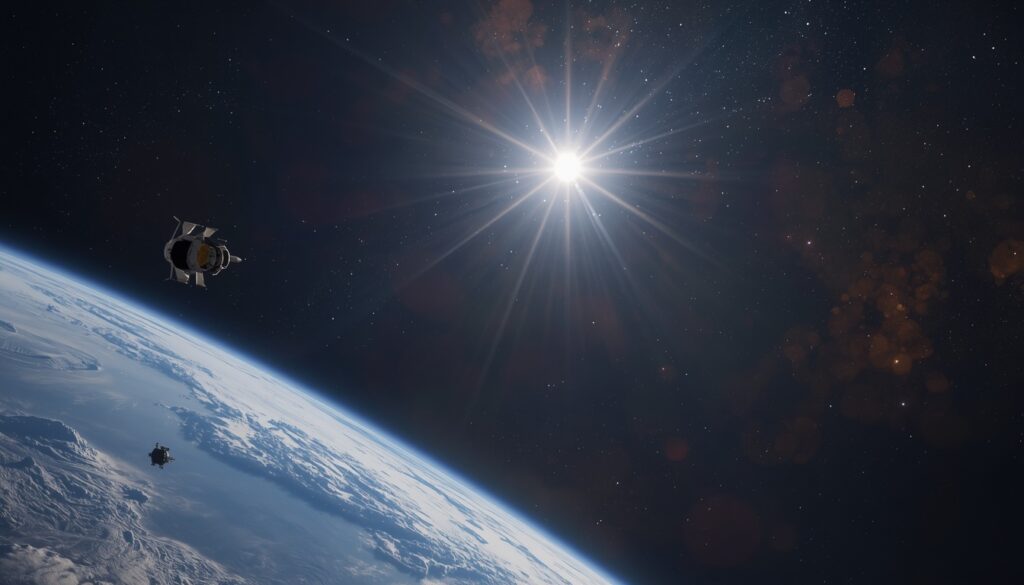
Artemis II Flight Day 4: Orion Crew Successfully Completes Manual Piloting Test in Deep Space

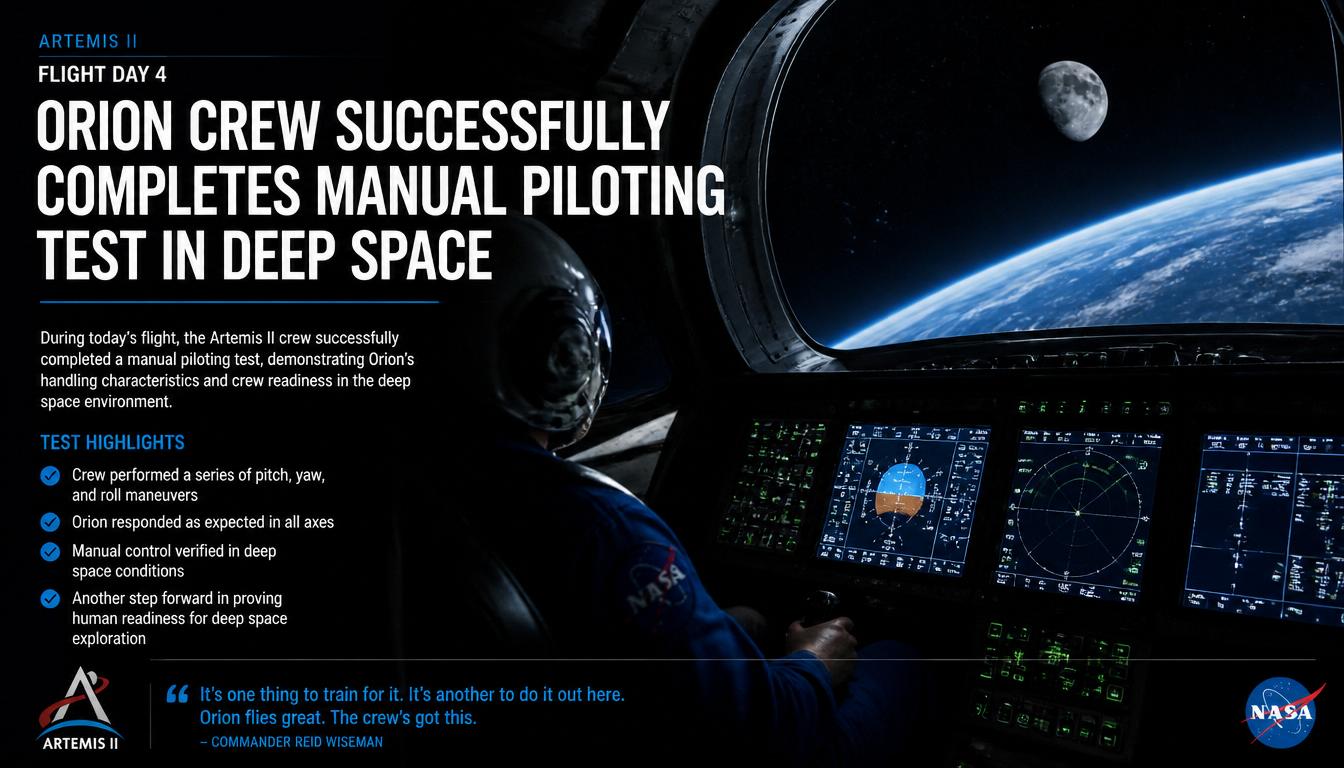
Artemis II Flight Day 4: Orion Crew Successfully Completes Manual Piloting Test in Deep Space
The NASA Artemis II mission achieved another important milestone during Flight Day 4 as astronauts aboard the Orion spacecraft successfully completed a manual piloting demonstration in deep space. The crew also reviewed detailed lunar flyby plans and prepared for upcoming scientific observations near the Moon.
As Orion continues traveling toward its historic lunar flyby, the mission is helping NASA gather valuable information about spacecraft handling, astronaut operations, and deep-space travel systems that will support future Moon and Mars missions.
Artemis II Continues Historic Journey Toward the Moon
The Artemis II crew remains on course during its journey around the Moon aboard the Orion spacecraft. This mission is NASA’s first crewed deep-space mission under the Artemis program and represents humanity’s return to lunar exploration after decades.
Throughout Flight Day 4, astronauts continued carrying out mission-critical tasks while traveling hundreds of thousands of miles away from Earth.
The mission not only tests Orion’s capabilities but also allows astronauts to gain experience operating in deep space conditions that future missions will encounter during long-duration exploration.
Manual Piloting Demonstration Begins in Orion
One of the biggest highlights of Flight Day 4 was the successful manual piloting demonstration inside Orion.
NASA astronaut Christina Koch and Canadian Space Agency astronaut Jeremy Hansen took turns manually controlling the spacecraft beginning at approximately 9:09 p.m. EDT.
The test lasted for around 41 minutes and allowed astronauts to evaluate Orion’s performance in deep space while engineers on Earth collected important operational data.
Manual piloting demonstrations are essential because they help NASA understand how astronauts can safely control spacecraft during future exploration missions beyond Earth orbit.
Testing Orion’s Thruster Modes and Movements
During the piloting exercise, the crew tested two different spacecraft thruster modes.
The astronauts practiced controlling Orion using:
- Six degrees of freedom movement
- Three degrees of freedom movement
These maneuvers allowed the crew to test how the spacecraft responds to various directional movements and rotational controls in the microgravity environment of deep space.
Engineers use this information to evaluate Orion’s stability, responsiveness, and maneuvering performance during crewed missions.
The tests also help astronauts become more familiar with spacecraft handling in preparation for future lunar and deep-space operations.
Reid Wiseman and Victor Glover to Repeat the Demonstration
NASA plans to repeat the manual piloting demonstration later in the mission.
Commander Reid Wiseman and pilot Victor Glover are expected to perform another piloting session during Flight Day 8.
Repeating the demonstration allows NASA engineers to gather additional data from different crew members and compare piloting techniques, handling experiences, and spacecraft responses.
Collecting information from multiple astronauts helps NASA improve spacecraft training procedures and mission planning for future Artemis missions.
Crew Reviews Lunar Flyby Observation Plans
Alongside spacecraft piloting tests, the Artemis II crew also spent time reviewing their upcoming lunar flyby operations.
NASA’s lunar science team provided the astronauts with a detailed list of lunar surface features that they will photograph and analyze during Orion’s six-hour flyby around the Moon.
The lunar observation period is scheduled to begin when Orion’s cabin windows face directly toward the Moon.
This phase of the mission is especially important because astronauts will have an opportunity to study the lunar surface from a unique perspective rarely experienced in human spaceflight history.
Astronauts Prepare to Photograph the Moon
During the flyby, astronauts will use cameras and direct visual observations to examine several important lunar surface features.
The crew is expected to observe:
- Large impact craters
- Ancient volcanic regions
- Surface ridges and cracks
- Bright and dark lunar terrain
- Polar regions near the Moon’s north and south poles
Astronaut observations provide scientists with valuable information about the Moon’s geology and surface composition.
By comparing differences in brightness, texture, and color, researchers can better understand how the Moon formed and evolved over billions of years.
Orion’s Unique View of the Moon
Unlike the Apollo missions, which passed much closer to the lunar surface, Orion’s flight path gives astronauts a wider perspective of the Moon.
The Artemis II crew will be able to view the entire lunar disk at once, including areas near the poles that are difficult to observe from Earth.
This unique vantage point allows astronauts to capture images and scientific observations that can support future Artemis missions and lunar exploration planning.
The mission also helps NASA test how astronauts perform scientific observation tasks while operating in deep space.
Crew Captures Selfies in Deep Space
Earlier during Flight Day 4, the astronauts also took several crew selfies using one of Orion’s external solar array wing cameras.
The camera system allows Orion to capture high-resolution images of both the spacecraft and the astronauts while traveling through space.
NASA plans to transmit these images back to Earth in the coming days using Orion’s advanced communication systems.
Spacecraft selfies have become popular moments during modern space missions because they allow the public to visually experience human exploration beyond Earth.
These images also help document the mission and provide engineers with additional views of spacecraft hardware during flight.
Daily Life Inside the Orion Spacecraft
Even while performing complex mission operations, astronauts aboard Orion continue following carefully planned daily schedules.
The crew balances:
- Spacecraft operations
- Scientific activities
- Exercise routines
- Communication tasks
- Meal schedules
- Sleep periods
NASA carefully manages astronaut schedules to ensure the crew remains healthy, focused, and productive during deep-space missions.
At the end of Flight Day 4, the astronauts prepared for their scheduled sleep period around 3:15 a.m.
Mission Control teams on Earth planned to wake the crew at noon to begin Flight Day 5 activities.
Importance of Manual Piloting for Future Missions
The manual piloting demonstrations conducted during Artemis II are extremely important for future exploration missions.
Although spacecraft can operate automatically for many tasks, astronauts must still be capable of manually controlling vehicles during emergencies, docking operations, or unexpected situations.
Future Artemis missions may involve:
- Lunar orbit operations
- Spacecraft docking procedures
- Lunar landing support
- Deep-space maneuvering
- Long-duration exploration missions
Testing astronaut piloting capabilities now helps NASA improve safety and operational readiness for future missions to the Moon and Mars.
Artemis II Helps Prepare for Human Mars Missions
The Artemis II mission is not only focused on the Moon. NASA is also using the mission to develop technologies and operational experience needed for eventual human missions to Mars.
Deep-space missions expose astronauts and spacecraft systems to unique challenges, including:
- Radiation exposure
- Long communication distances
- Microgravity effects
- Isolation from Earth
- Complex spacecraft operations
By testing Orion and astronaut performance during Artemis II, NASA gains critical information for future interplanetary missions.
Public Interest in Artemis II Continues Growing
The Artemis II mission continues attracting worldwide attention as millions of people follow updates through social media, NASA broadcasts, and live mission coverage.
The mission represents a major step forward in human space exploration and demonstrates international cooperation between NASA and the Canadian Space Agency.
As Orion approaches its lunar flyby, excitement continues building around the mission’s scientific goals and historic achievements.
Conclusion
Flight Day 4 of the Artemis II mission showcased the advanced capabilities of the Orion spacecraft and the professionalism of the astronaut crew. From manual piloting demonstrations and lunar flyby preparation to scientific observation planning and spacecraft photography, the mission continues achieving major milestones in deep-space exploration.
The experiences gained during Artemis II will help NASA prepare for future lunar landings, long-duration Moon missions, and eventual human journeys to Mars.
FAQs
What happened during Artemis II Flight Day 4?
The crew completed a manual piloting demonstration, reviewed lunar flyby plans, and prepared for scientific observations of the Moon.
Who controlled the Orion spacecraft during the piloting test?
Christina Koch and Jeremy Hansen manually controlled Orion during the deep-space piloting demonstration.
Why is manual spacecraft piloting important?
Manual piloting helps astronauts prepare for emergencies, docking operations, and future deep-space missions.
What are six degrees of freedom?
Six degrees of freedom refer to spacecraft movement in multiple directions and rotations during piloting operations.
Will Artemis II land on the Moon?
No, Artemis II is a crewed lunar flyby mission and will not land astronauts on the Moon.
What will astronauts observe during the lunar flyby?
The crew will study craters, lava plains, ridges, polar regions, and other lunar surface features.
Why are astronauts taking pictures of the Moon?
The photographs help scientists study lunar geology and prepare for future Artemis missions.
What spacecraft is being used for Artemis II?
NASA is using the Orion spacecraft for the Artemis II mission.
Why are crew selfies important during space missions?
Crew selfies help document missions, engage the public, and provide additional spacecraft inspection views.
How does Artemis II help future Mars missions?
The mission helps NASA test deep-space technologies, astronaut operations, communication systems, and spacecraft performance needed for Mars exploration.