Artemis II Flight Day 5: Orion Crew Begins Critical Space Suit Demonstration Near the Moon

Updated
Artemis II Flight Day 5: Orion Crew Begins Critical Space Suit Demonstration Near the Moon
The NASA Artemis II mission continued its historic journey toward the Moon during Flight Day 5 as astronauts aboard the Orion spacecraft conducted an important space suit demonstration and prepared to enter the Moon’s gravitational influence.
Traveling approximately 65,235 miles away from the Moon, the crew focused on testing the Orion Crew Survival System suits, reviewing final lunar science targets, and preparing for upcoming mission milestones. Flight Day 5 highlighted both the technical and emotional importance of NASA’s return to deep-space human exploration.
Artemis II Crew Wakes Up for Another Day in Deep Space
The astronauts aboard Orion began their day with music as they prepared for another demanding schedule in space. NASA selected “Working Class Heroes (Work)” by CeeLo Green as the crew wake-up song for Flight Day 5.
The crew members — Reid Wiseman, Victor Glover, Christina Koch, and Canadian Space Agency astronaut Jeremy Hansen — continued traveling closer to the Moon aboard Orion while completing mission-critical activities.
At this stage of the mission, the astronauts had already spent several days in deep space and were approaching one of the most important moments of the journey: the lunar flyby.
Historic Views of the Moon Continue
NASA also released a remarkable image captured by the Artemis II crew during their journey.
The photograph showed the Moon with its South Pole positioned at the top of the image while revealing portions of the lunar far side. One of the most significant features visible in the photo was the Orientale Basin, located near the right edge of the lunar disk.
The Orientale Basin is considered one of the best examples of a multi-ring impact crater in the solar system. Scientists use it as an important comparison model when studying impact structures on planets and moons throughout the solar system, including Mercury and Pluto.
According to NASA, Artemis II marks the first time humans have observed the entire Orientale Basin from this perspective.
Charlie Duke Sends Special Message to Artemis II Crew
One of the emotional highlights of Flight Day 5 came when Apollo 16 astronaut Charlie Duke sent a special message to the Artemis II crew.
Charlie Duke reminded the astronauts that he and Apollo astronaut John Young landed on the Moon in 1972 using a lunar module named Orion. He expressed excitement that a new spacecraft carrying the same name is now helping return humans toward the Moon.
Duke also mentioned a famous personal detail from the Apollo 16 mission — a photograph of his family that remains on the Moon’s surface today.
His message reflected the strong connection between the Apollo era and NASA’s modern Artemis program.
Orion Crew Begins Space Suit Demonstration
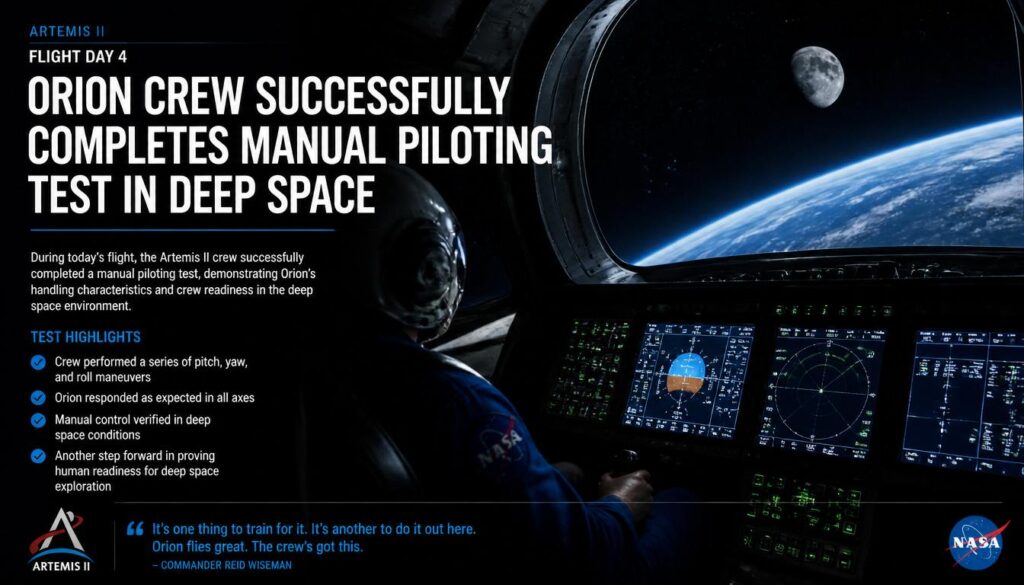
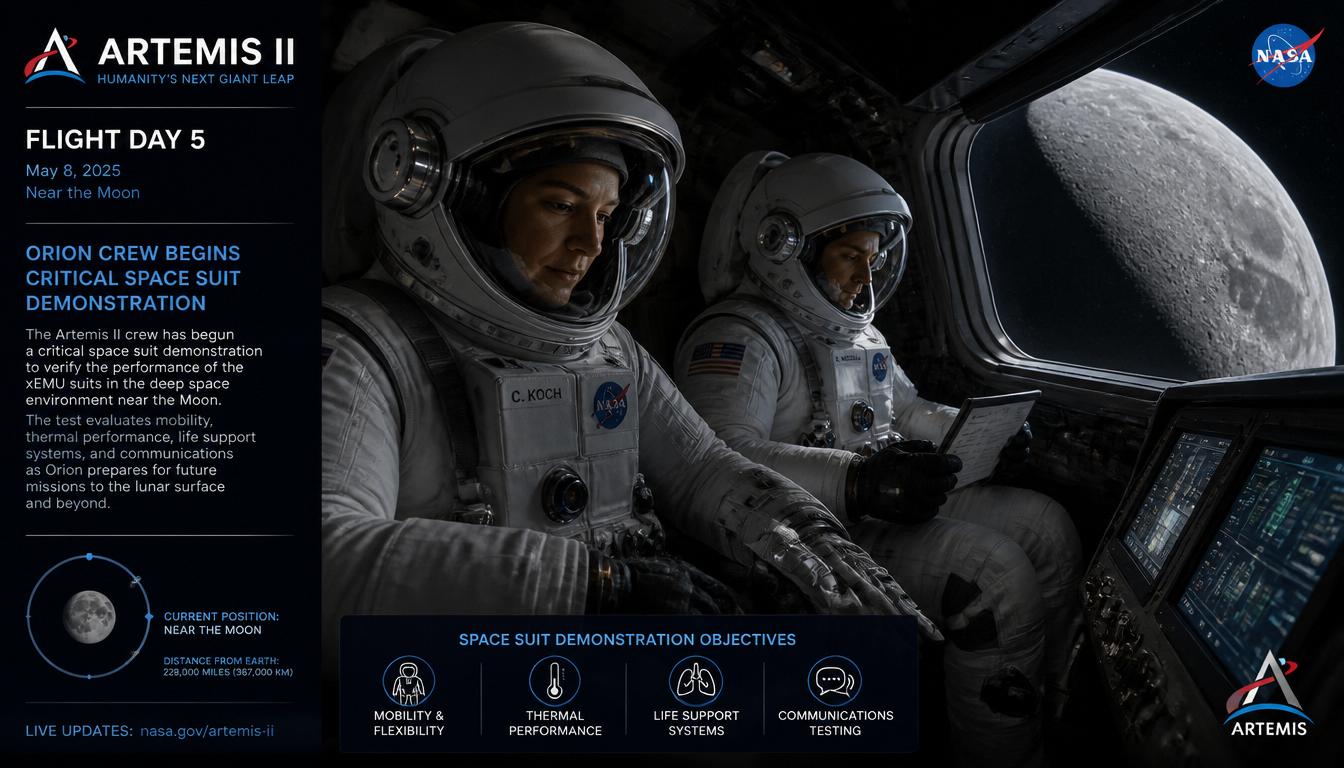
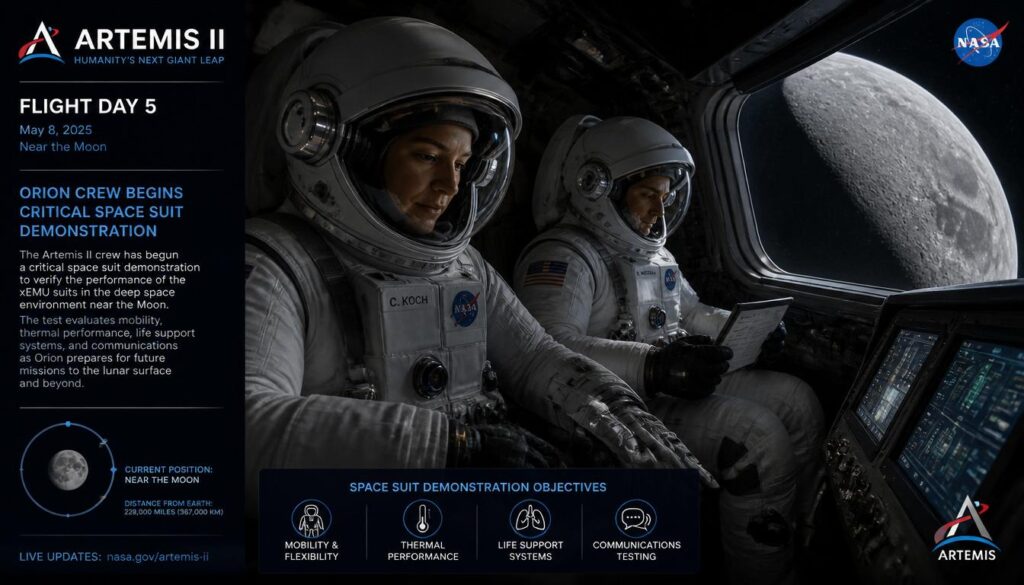
The main objective of Flight Day 5 focused on evaluating the Orion Crew Survival System suits.
The astronauts performed a complete suit operation sequence inside the spacecraft. These procedures included:
- Putting on the suits
- Pressurizing the suits
- Performing leak checks
- Simulating seat entry procedures
- Testing astronaut mobility
- Evaluating eating and drinking capabilities while suited
NASA uses these demonstrations to study how the suits function during extended periods in microgravity and deep-space conditions.
The information gathered during the tests will help improve astronaut safety and comfort during future Artemis missions.
Why the Orion Crew Survival System Suits Matter
The Orion Crew Survival System suits are specially designed to protect astronauts during critical mission phases.
These suits provide important safety functions, including:
- Protection during launch and reentry
- Emergency life support during cabin depressurization
- Thermal management
- Communication support
- Splashdown survival capabilities
NASA designed the suits specifically for Artemis missions and future deep-space exploration.
Unlike earlier space suits used during the Apollo era, the Orion suits include enhanced mobility systems, updated communication technology, and improved comfort for long-duration missions.
Testing these suits during Artemis II helps NASA verify that astronauts can safely operate in deep-space environments.
Microgravity Testing Provides Valuable Data
One important goal of the suit demonstration involved studying astronaut movement and comfort in microgravity.
Living and working in weightlessness creates unique challenges for astronauts. Simple tasks like moving, eating, and adjusting equipment can become difficult in space.
NASA carefully studies how astronauts interact with their suits in microgravity because future lunar and Mars missions may require astronauts to wear suits for extended periods.
The Flight Day 5 demonstration provided engineers with valuable information about suit flexibility, mobility, and crew efficiency.
Orion Approaches Moon’s Gravitational Sphere of Influence
Later during Flight Day 5, Orion was expected to enter the Moon’s gravitational sphere of influence.
This milestone means that the Moon’s gravity would begin affecting Orion’s trajectory more strongly than Earth’s gravity.
Entering the lunar gravitational region is one of the most important navigation milestones during the mission because it confirms Orion is successfully approaching the Moon for its planned flyby.
NASA engineers continuously monitor spacecraft trajectory data to ensure Orion remains on the correct flight path.
Outbound Trajectory Correction Burn Planned
Mission teams also scheduled an outbound trajectory correction burn during Flight Day 5.
Trajectory correction burns are small engine firings used to fine-tune the spacecraft’s flight path. These maneuvers help ensure Orion follows the correct route around the Moon before returning safely to Earth.
Precise navigation is extremely important during deep-space missions because even small flight path errors can become significant over long distances.
NASA carefully calculates these burns to maximize mission efficiency and fuel usage.
Final Lunar Science Targets Sent to Crew
As the lunar flyby approached, NASA’s science teams delivered final observation targets to the astronauts.
The crew will use these targets to guide scientific observations during their six-hour lunar flyby period.
Astronauts will study and photograph several important lunar features, including:
- Impact craters
- Volcanic regions
- Surface ridges
- Polar areas
- Ancient lava plains
These observations help scientists better understand the Moon’s geology, surface history, and long-term evolution.
The Artemis II mission combines human exploration with scientific discovery, continuing NASA’s tradition of lunar research.
Artemis II Supports Future Lunar Missions
Although Artemis II will not land astronauts on the Moon, the mission is extremely important for future exploration goals.
NASA is using Artemis II to test:
- Deep-space spacecraft systems
- Crew operations
- Navigation technologies
- Space suit performance
- Scientific observation procedures
- Long-duration mission planning
The lessons learned during Artemis II will directly support future missions such as Artemis III, which is expected to land astronauts on the lunar surface.
NASA also hopes the Artemis program will eventually help prepare humans for missions to Mars.
Public Interest in Artemis II Continues Growing
The Artemis II mission has captured worldwide attention as people follow the crew’s progress toward the Moon.
NASA continues sharing updates, images, and live broadcasts through social media platforms and online coverage.
The mission represents one of humanity’s most important modern space exploration efforts and symbolizes a return to deep-space human travel after decades of limited lunar missions.
International cooperation between NASA and the Canadian Space Agency also highlights the global nature of modern space exploration.
Conclusion
Flight Day 5 of the Artemis II mission demonstrated the importance of astronaut safety, advanced technology, and deep-space preparation as Orion continued its historic journey toward the Moon.
From testing the Orion Crew Survival System suits to preparing for lunar scientific observations, the crew continues making important progress on NASA’s path toward future lunar exploration.
As Artemis II approaches its lunar flyby, the mission remains a major step toward humanity’s return to the Moon and the future of deep-space exploration.
FAQs
What happened during Artemis II Flight Day 5?
The crew performed a full space suit demonstration, prepared for lunar observations, and approached the Moon’s gravitational sphere of influence.
What are Orion Crew Survival System suits?
They are specialized astronaut suits designed to provide protection, life support, communication, and survival capabilities during Artemis missions.
Why did NASA test the suits in space?
NASA wanted to evaluate suit performance, mobility, comfort, and safety during long-duration microgravity operations.
What is the Orientale Basin?
The Orientale Basin is a large multi-ring impact crater on the Moon used by scientists to study planetary impacts across the solar system.
Who sent a message to the Artemis II crew?
Apollo 16 astronaut Charlie Duke sent a special message encouraging the Artemis II astronauts.
What is the Moon’s gravitational sphere of influence?
It is the region where the Moon’s gravity becomes the dominant force affecting Orion’s trajectory.
Will Artemis II land on the Moon?
No, Artemis II is a lunar flyby mission and will not include a Moon landing.
Why are trajectory correction burns important?
These engine firings help adjust Orion’s flight path to ensure accurate navigation during the mission.
What scientific observations will the crew perform?
Astronauts will photograph and study lunar craters, volcanic plains, ridges, and polar regions during the flyby.
Why is Artemis II important for future missions?
The mission helps NASA test technologies, astronaut operations, and spacecraft systems needed for future Moon landings and Mars missions.