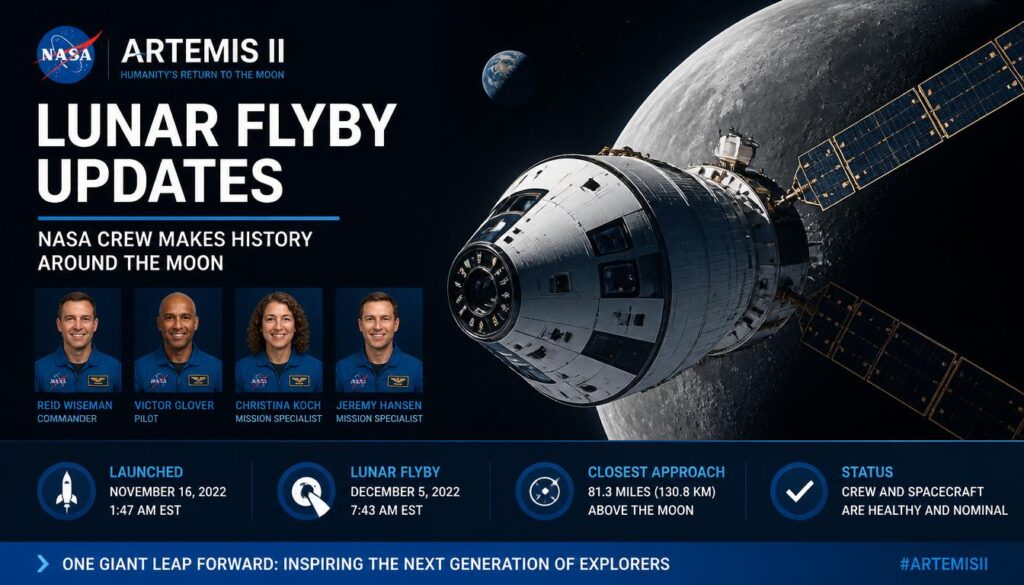
Artemis II Lunar Flyby Updates: NASA Crew Makes History Around the Moon in a Historic Achievement in 2026

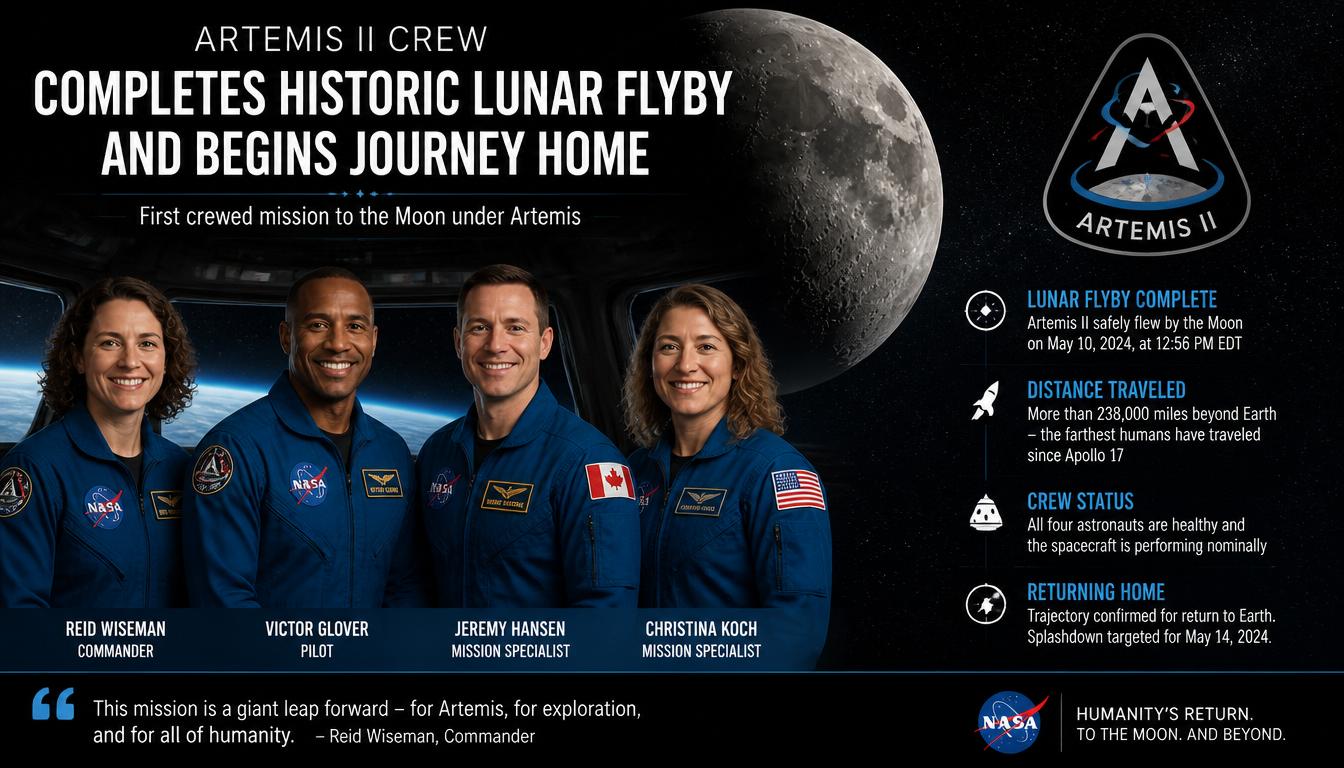
Artemis II Lunar Flyby Updates: NASA Crew Makes History Around the Moon in a Historic Achievement in 2026
Humanity has officially completed another historic chapter in deep-space exploration as the crew of Artemis II Mission wrapped up its successful lunar flyby around the Moon. The mission marked the first time humans traveled around the Moon since the famous Apollo 17 mission in 1972.
During Flight Day 6, the astronauts aboard the Orion spacecraft broke records, studied the Moon’s far side, witnessed Earthrise and Earthset, and even observed a rare solar eclipse from deep space. The mission has become one of the most important achievements in modern space exploration and a major step toward future human missions to Mars.
Artemis II Successfully Completes Seven-Hour Lunar Flyby
The Artemis II crew completed a seven-hour observation period around the Moon, giving scientists and space enthusiasts a remarkable view of Earth’s closest neighbor.
During the flyby, astronauts carefully studied the Moon’s surface using both cameras and direct visual observations. The crew documented lunar craters, lava plains, ridges, and surface cracks that reveal the Moon’s ancient geological history.
This mission provided scientists with fresh information about the Moon while also testing critical systems needed for future lunar landings.
The success of the lunar flyby proves that NASA’s Orion spacecraft is capable of safely transporting astronauts through deep space and back to Earth.
Meet the Artemis II Astronaut Crew
The Artemis II mission includes four astronauts representing the United States and Canada:
- Reid Wiseman
- Victor Glover
- Christina Koch
- Jeremy Hansen
These astronauts became the first humans in more than 50 years to travel around the Moon.
Their mission is helping NASA test deep-space travel technologies, astronaut safety systems, and communication procedures that will be essential for future missions under the Artemis program.
Artemis II Sets New Human Spaceflight Distance Record
One of the biggest milestones during Flight Day 6 came when the Orion spacecraft traveled farther from Earth than any previous human mission.
At 1:56 p.m. EDT, the Artemis II crew officially broke the record previously held by Apollo 13 astronauts. Orion eventually reached a maximum distance of approximately 252,756 miles from Earth.
This achievement highlights how modern spacecraft technology has advanced beyond the capabilities of the Apollo era.
Breaking the distance record was not just symbolic — it demonstrated that astronauts can safely travel farther into deep space than ever before.
Closest Approach to the Moon During Communications Blackout
As Orion passed behind the Moon, the spacecraft entered a planned communications blackout lasting around 40 minutes.
This temporary signal loss occurred because the Moon blocked radio communication between the spacecraft and NASA’s Deep Space Network on Earth.
During the blackout, the crew experienced one of the mission’s most important moments — Orion’s closest approach to the Moon. The spacecraft flew approximately 4,067 miles above the lunar surface.
Even though Mission Control could not communicate with the astronauts during this period, the event was carefully planned and expected.
Similar communication blackouts occurred during Apollo missions and the uncrewed Artemis I mission.
Exploring the Moon’s Far Side
One of the most exciting aspects of the mission was the opportunity to observe the Moon’s mysterious far side.
Unlike the side visible from Earth, the lunar far side remains less familiar to most people. During the flyby, astronauts photographed impact craters, ancient lava flows, and massive surface ridges.
The crew also noticed differences in color, brightness, and texture across various regions of the Moon. These visual details help scientists better understand the Moon’s mineral composition and geological evolution.
By studying these surface features directly, researchers can gather valuable information about how the Moon formed billions of years ago.
Earthset and Earthrise Create Emotional Moments in Space
As Orion traveled behind the Moon, the astronauts witnessed a breathtaking “Earthset” — the moment Earth disappeared below the lunar horizon.
Later, as the spacecraft emerged from the opposite side of the Moon, the crew experienced an incredible “Earthrise.”
These stunning moments reminded many people of the famous Earthrise image captured during the Apollo era, which forever changed humanity’s perspective on Earth and space exploration.
Seeing Earth from deep space often creates a powerful emotional effect on astronauts, highlighting the beauty and fragility of our planet.
Rare Solar Eclipse Observed from Deep Space
Near the end of the lunar observation period, the astronauts experienced another extraordinary event — a solar eclipse viewed from deep space.
As Orion, the Moon, and the Sun aligned, the crew saw the Sun disappear behind the Moon for nearly one hour.
This rare opportunity allowed astronauts to study the solar corona, which is the outer atmosphere of the Sun. Scientists are interested in the corona because it plays a major role in solar storms and space weather.
Understanding solar activity is important for protecting future astronauts, satellites, and communication systems during long-duration space missions.
Very few humans have ever observed a solar eclipse from such a distant location in space.
Meteoroid Impacts Spotted on the Moon
During the eclipse, the astronauts reported seeing six bright flashes caused by meteoroids striking the Moon’s surface.
These meteoroids travel at extremely high speeds and create flashes of light when they collide with the lunar ground.
Scientists are especially interested in these observations because meteoroid impacts could represent a potential danger for future astronauts living or working on the Moon.
NASA researchers will now analyze the images and data collected during the flyby to determine the exact locations and timing of these impacts.
Scientists also plan to compare astronaut observations with reports from amateur astronomers who were observing the Moon from Earth at the same time.
NASA and President Donald Trump Congratulate the Crew
Following the successful lunar flyby, the astronauts participated in a live conversation with Donald Trump.
The crew also spoke with Jared Isaacman and answered questions submitted through social media.
The live broadcast allowed millions of viewers around the world to celebrate the mission’s historic achievements alongside the astronauts.
NASA’s global livestream coverage helped inspire excitement about deep-space exploration and future Moon missions.
Why Artemis II Is Important for the Future of Space Exploration
The Artemis II mission is much more than a simple trip around the Moon. It is a critical test mission that will shape the future of human exploration beyond Earth orbit.
NASA is using the mission to evaluate:
- Deep-space navigation systems
- Human survival in space
- Radiation protection technology
- Communication systems
- Lunar observation techniques
- Spacecraft safety performance
The lessons learned from Artemis II will directly support future Artemis missions that aim to land astronauts on the Moon and eventually send humans to Mars.
Artemis Program and the Return to the Moon
The Artemis program represents NASA’s long-term vision for human space exploration.
Future Artemis missions are expected to establish a sustainable human presence on the Moon, develop lunar habitats, and prepare astronauts for journeys deeper into the solar system.
Artemis II serves as a major stepping stone toward those ambitious goals.
By successfully completing this mission, NASA has proven that humanity is once again capable of traveling safely beyond low Earth orbit.
FAQs About Artemis II Lunar Flyby
What is Artemis II?
NASA Artemis II is the first crewed mission of NASA’s Artemis program designed to send astronauts around the Moon aboard the Orion spacecraft.
What was the distance between Earth and the Artemis II spacecraft?
The mission reached approximately 252,756 miles from Earth, setting a new record for human spaceflight.
What is the Orion spacecraft?
Orion Spacecraft Orion is NASA’s advanced spacecraft created for long-distance human missions beyond Earth orbit.
Why was there a communication blackout?
The Moon blocked radio signals between Orion and Earth while the spacecraft traveled behind the lunar far side.
What did astronauts observe on the Moon?
The crew studied impact craters, lava flows, surface ridges, color variations, and meteoroid impacts on the lunar surface.
What is Earthrise?
Earthrise occurs when Earth becomes visible above the Moon’s horizon from the perspective of a spacecraft or astronaut.
Why was the solar eclipse important?
The eclipse allowed astronauts to study the Sun’s corona and observe rare lunar phenomena during deep-space travel.
Did Artemis II land on the Moon?
No, Artemis II only performed a lunar flyby mission and did not land on the lunar surface.
Why is Artemis II historically important?
The mission marked humanity’s first return to the Moon region since Apollo 17 in 1972 and set a new distance record for human spaceflight.
Conclusion
The Artemis II lunar flyby has become one of the most important milestones in modern space exploration. From setting distance records to capturing images of the Moon’s far side and witnessing a rare solar eclipse, the mission demonstrated humanity’s growing ability to explore deep space.
As Orion continues its journey back to Earth, Artemis II has already inspired millions around the world and laid the groundwork for future missions to the Moon and Mars.