Historic Artemis II: NASA Approves Translunar Injection Burn on Flight Day 2 – A Bright Leap for Lunar Exploration

Historic Artemis II: NASA Approves Translunar Injection Burn on Flight Day 2 – A Bright Leap for Lunar Exploration
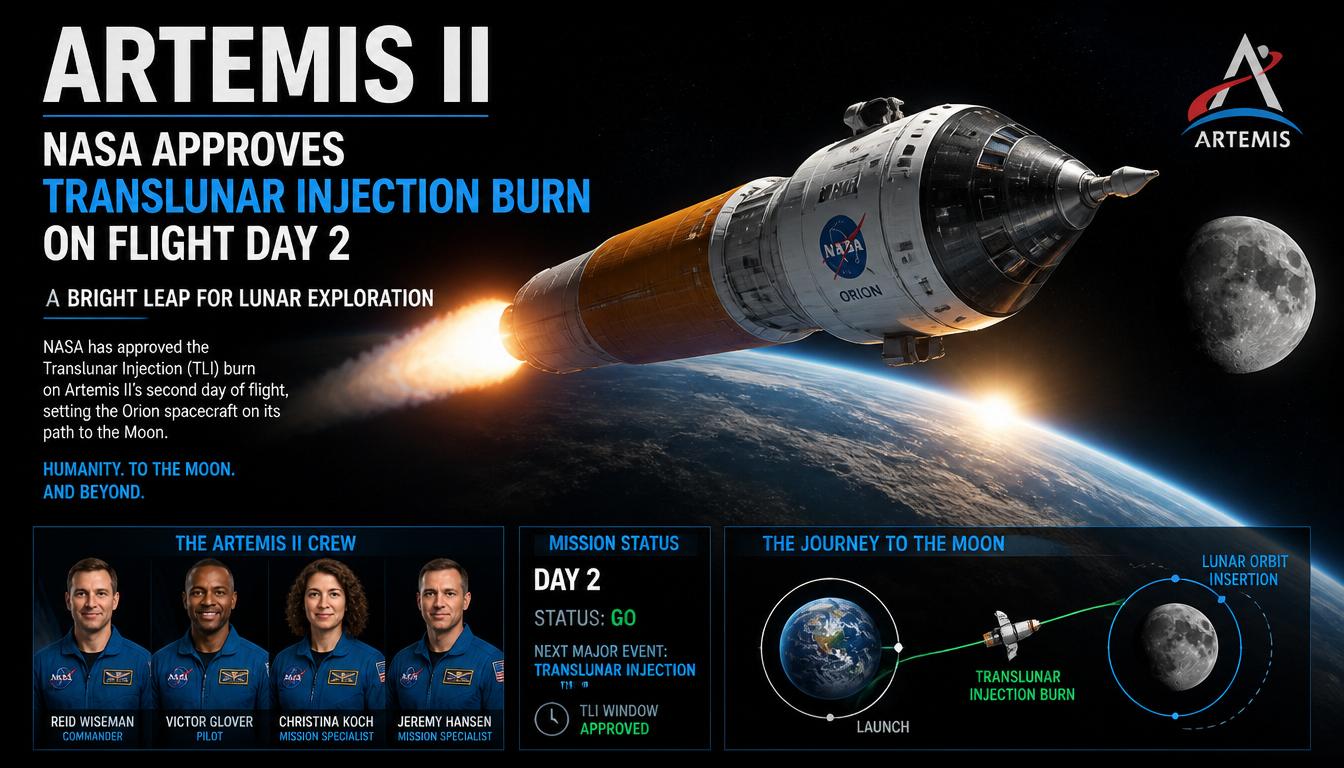
NASA’s Artemis II mission has officially entered one of the most historic phases of modern human space exploration as mission controllers and astronauts received the official “Go” for the translunar injection burn that will send the Orion spacecraft toward the Moon.
The major milestone comes during Flight Day 2 of the Artemis II mission and marks humanity’s return to deep space travel beyond low Earth orbit for the first time since the Apollo 17 mission in 1972.
NASA’s mission management team carefully reviewed spacecraft systems, astronaut conditions, and flight data before approving the critical maneuver. The successful approval clears the way for Orion to leave Earth orbit and begin its long journey around Earth’s closest celestial neighbor.
The Artemis II mission includes NASA astronauts Reid Wiseman, Victor Glover, Christina Koch, and Canadian astronaut Jeremy Hansen.
NASA Mission Management Team Approves Translunar Injection Burn
One of the most important moments of the Artemis II mission occurred when NASA’s mission management team officially polled “Go” for the translunar injection burn.
Before approving the maneuver, engineers and mission specialists spent hours reviewing Orion’s systems, propulsion performance, navigation data, communication systems, and astronaut safety conditions.
After confirming that the spacecraft was functioning perfectly, the mission team authorized Orion to proceed with the burn that will send astronauts beyond Earth orbit and toward the Moon.
This approval represents a major achievement because the translunar injection burn is one of the most critical operations during the entire mission.
What Is the Translunar Injection Burn?
The translunar injection burn is a powerful engine maneuver that allows a spacecraft to escape Earth orbit and begin traveling toward the Moon.
For Artemis II, Orion’s main engine on the service module will fire for approximately five minutes and 49 seconds beginning at 7:49 p.m. EDT.
During the burn, the spacecraft will dramatically increase its speed and enter a trajectory that carries the astronauts away from Earth and into deep space.
This maneuver is considered historic because no human mission has traveled beyond low Earth orbit since NASA’s Apollo 17 mission more than five decades ago.
The translunar injection burn effectively marks the official start of Orion’s lunar journey.
Orion’s Powerful Main Engine Plays Key Role
The Orion spacecraft relies on its powerful service module engine to perform major orbital maneuvers during the mission.
NASA explained that Orion’s main engine can generate up to 6,000 pounds of thrust. To help people understand the engine’s power, NASA compared its acceleration capability to a car reaching 0 to 60 miles per hour in approximately 2.7 seconds.
Although spacecraft operate differently than vehicles on Earth, this comparison highlights the incredible amount of force needed to move astronauts through space.
The engine must perform with extreme precision because even small navigation errors could affect Orion’s trajectory toward the Moon.
NASA flight controllers will closely monitor engine performance and guidance systems throughout the maneuver.
Artemis II Astronauts Begin Their First Full Day in Space
The Artemis II astronauts officially began their first full operational day in space at 2:35 p.m. EDT.
Mission control woke the crew with the song “Green Light” by John Legend and Andre 3000, continuing NASA’s long tradition of using music to wake astronauts during space missions.
After waking up, the astronauts began preparing for the translunar injection burn while also carrying out daily spacecraft activities and system checks.
Life aboard Orion involves constant coordination between astronauts and mission control teams to ensure the spacecraft remains safe and fully operational during every phase of the mission.
Crew Members Prepare for Deep Space Travel
As the mission transitions from Earth orbit toward the Moon, the astronauts are beginning to adapt to longer-duration spaceflight conditions.
The crew is carefully monitoring spacecraft systems, reviewing procedures, and preparing equipment needed for upcoming mission activities around the Moon.
Unlike short orbital flights near Earth, deep space missions require astronauts to manage extended periods in microgravity while operating far from Earth’s immediate support systems.
Artemis II serves as an important test flight to help NASA understand how astronauts and spacecraft systems perform during deep space travel.
The experience gained from this mission will directly support future lunar landing missions under the Artemis program.
Astronauts Begin Exercise Sessions in Space
One important activity scheduled during Flight Day 2 involves the crew’s first exercise sessions aboard Orion.
Astronauts will use Orion’s flywheel exercise device, which is designed to help maintain physical fitness during long-duration space missions.
Exercise is extremely important in space because microgravity environments can weaken muscles and reduce bone density over time. Regular workouts help astronauts maintain their health and physical strength while living in space.
NASA carefully plans astronaut exercise routines during missions to reduce the physical effects of weightlessness.
Although Artemis II is shorter than future lunar or Mars missions, NASA still uses the mission to test exercise procedures and astronaut health systems.
Orion Continues Operating Normally
NASA engineers confirmed that Orion’s systems continue operating within expected ranges as the mission moves closer to the Moon.
The spacecraft’s propulsion systems, navigation equipment, communication systems, thermal controls, and solar power systems all remain stable following earlier orbital maneuvers.
Previous mission milestones, including the apogee raise burn, perigee raise burn, and proximity operations demonstration, were completed successfully.
These achievements continue increasing confidence in Orion’s ability to safely transport astronauts during future deep space exploration missions.
Artemis II Marks Humanity’s Return Beyond Low Earth Orbit
One of the most exciting aspects of Artemis II is its historical importance.
Since the Apollo program ended in the 1970s, humans have remained primarily in low Earth orbit aboard spacecraft such as the Space Shuttle and the International Space Station.
Artemis II changes that by sending astronauts farther into space than any human mission in more than 50 years.
The mission represents a major step toward NASA’s long-term goal of establishing sustainable lunar exploration and eventually sending humans to Mars.
For many space enthusiasts around the world, Artemis II symbolizes the beginning of a new era in human space exploration.
The future of lunar exploration and NASA’s Artemis Program
The Artemis program was created to return humans to the Moon while developing technologies needed for future deep space missions.
Unlike the Apollo program, Artemis focuses on long-term exploration rather than short visits. NASA plans to build sustainable infrastructure near and on the Moon, including lunar habitats, advanced spacecraft systems, and future lunar stations.
Artemis II plays a critical role in these plans because it allows NASA to test the Orion spacecraft and astronaut operations before future missions attempt lunar landings.
The mission also demonstrates growing international cooperation in space exploration, including participation from the Canadian Space Agency.
Mission Control Teams Continue Monitoring Every System
Throughout the mission, NASA flight controllers remain focused on monitoring Orion’s systems around the clock.
Teams in mission control carefully track navigation data, engine performance, crew health, communication signals, and spacecraft temperatures to ensure everything operates safely.
Mission control specialists also provide astronauts with technical support and guidance during critical maneuvers like the translunar injection burn.
The successful coordination between astronauts and ground teams remains one of the most important parts of modern space exploration.
The World Watches Artemis II’s Historic Journey
As Artemis II prepares to leave Earth orbit, millions of people around the world are following the mission closely.
NASA continues sharing mission updates, images, and live coverage through its official platforms, giving the public a chance to witness one of the most important human spaceflight missions in decades.
The mission both progresses scientific knowledge and exploration, and serves as an inspiration for coming generations who are passionate about space technology, engineering, and astronomy.
With the translunar injection burn approaching, Artemis II stands on the edge of another historic milestone in humanity’s journey beyond Earth.
Frequently Asked Questions (FAQs)
What is the translunar injection burn?
The translunar injection burn is a major engine firing that sends the Orion spacecraft out of Earth orbit and toward the Moon.
Why is Artemis II historically important?
Artemis II will be the first human mission to travel beyond low Earth orbit since Apollo 17 in 1972.
How long will Orion’s engine fire during the burn?
The spacecraft’s main engine will fire for approximately five minutes and 49 seconds.
Who are the astronauts aboard Artemis II?
The crew includes Reid Wiseman, Victor Glover, Christina Koch, and Jeremy Hansen.
What is Orion’s main engine used for?
The engine performs major orbital maneuvers, including the translunar injection burn that sends Orion toward the Moon.
Why do astronauts exercise in space?
Exercise helps astronauts maintain muscle strength and bone health in microgravity environments.
What does NASA’s mission management team do?
The team reviews spacecraft systems and mission data before approving major mission activities.
What is the Artemis program aiming to achieve?
The goal of NASA’s Artemis program is to send humans back to the Moon and lay the groundwork for upcoming missions to Mars.