8 Fascinating Realities of Daily Life Aboard ISS

Updated

Daily Life Aboard ISS:
For the astronauts who call it home for months at a time, daily life aboard ISS looks nothing like a typical workday on Earth. Orbiting the planet roughly every ninety minutes, crew members experience sixteen sunrises and sunsets every single day, all while following a meticulously planned schedule designed to maximize scientific output and maintain physical and mental health in microgravity.
1. The Day Follows a Strict Earth-Based Schedule
Despite orbiting far above any single time zone, this daily routine in orbit follows Greenwich Mean Time, giving astronauts a consistent 24-hour schedule for waking, working, eating, and sleeping that helps regulate their circadian rhythms despite the disorienting cycle of sixteen sunrises each day.
2. Sleeping Requires Being Strapped In
Because there is no “down” in microgravity, this daily routine in orbit includes sleeping in small, personal crew quarters where astronauts zip themselves into sleeping bags attached to the wall, preventing them from floating around the cabin and colliding with equipment during their designated eight-hour sleep period.
3. Meals Require Careful Planning and Rehydration
Food is one of the more unusual aspects of this daily routine in orbit, with many meals consisting of dehydrated or thermostabilized items that require adding hot or cold water before eating, while astronauts use magnets, velcro, and clips to keep utensils and food packages from floating away during meals.
4. Exercise Is Mandatory, Not Optional
To combat the muscle and bone density loss that comes with extended microgravity exposure, this daily routine in orbit includes a mandatory two-hour exercise regimen using specialized equipment like a treadmill with harnesses, a stationary bicycle, and a resistance exercise device that simulates weightlifting without actual gravity.
5. Hygiene Looks Completely Different Without Running Water
Traditional showers don’t exist in this daily routine in orbit; instead, astronauts use rinseless soap, specialized shampoo that doesn’t require water, and wet wipes for personal hygiene, while the station’s toilet uses airflow rather than gravity to manage waste in microgravity conditions.
6. Work Hours Are Dedicated to Scientific Research
A significant portion of daily routine in orbit revolves around conducting scientific experiments spanning biology, physics, materials science, and human health research, with astronauts often serving as both researchers and test subjects for studies examining how the human body adapts to long-duration spaceflight.
7. Free Time Still Exists, Even in Space
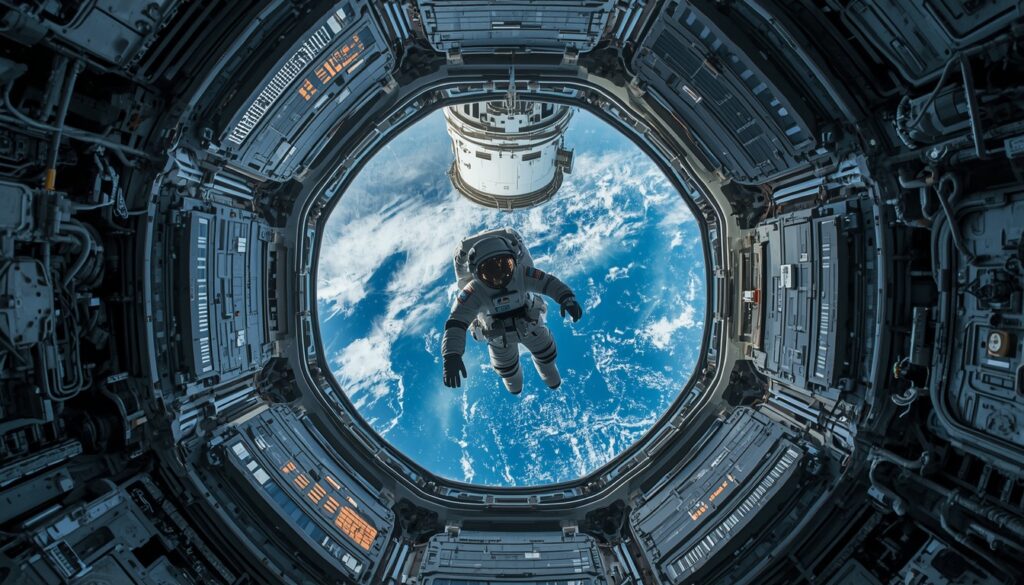
Despite demanding schedules, this daily routine in orbit includes scheduled personal time, during which astronauts read, watch movies, play musical instruments, or simply spend time gazing out the station’s cupola window at Earth, an activity many crew members describe as one of the most meditative parts of their mission.
8. Communication With Family Happens Regularly
Modern daily life aboard ISS includes internet access and video calling capabilities that allow astronauts to stay connected with family and friends on Earth, a significant improvement over the limited, delayed communication available to astronauts during earlier eras of human spaceflight.
Why Understanding This Routine Matters
Studying daily life aboard ISS provides critical data for planning future long-duration missions to the Moon and Mars, where astronauts will face even greater isolation and communication delays than ISS crew members currently experience. Every aspect of station life, from sleep patterns to exercise routines, has been refined over more than two decades of continuous human presence in orbit.
Researchers use this accumulated knowledge to design better habitats, nutrition plans, and psychological support systems for future deep space missions, making the ISS not just a scientific laboratory but also a genuine proving ground for the human factors that will determine whether longer missions beyond low Earth orbit succeed.
The Psychological Side of Life in Orbit
Beyond the physical routines, this daily routine in orbit also involves significant psychological adaptation, as astronauts learn to cope with confinement, limited privacy, and separation from loved ones for months at a stretch. NASA and international partner space agencies provide extensive psychological support, including regular video conferences with family, private communication channels, and pre-flight training designed to prepare astronauts for the isolation they’ll experience.
Crew cohesion also plays an enormous role in mission success, with astronauts from different countries and cultural backgrounds needing to work closely together in a confined space for extended periods, a dynamic that has made the International Space Station as much a study in human cooperation as it is a scientific research platform.
How the Environment Shapes Everyday Behavior
Every aspect of this daily routine in orbit is shaped by the constraints of microgravity in ways that take new astronauts weeks to fully adapt to. Simple tasks that require no thought on Earth — pouring a drink, using a tool, or even turning around in a corridor — demand entirely new physical habits when there is no consistent “up” or “down” to orient by, and objects don’t stay put unless deliberately secured.
Veteran astronauts often describe an adjustment period during which they learn to move efficiently through the station, using handholds and practiced motions rather than the walking and reaching patterns that feel automatic on Earth. This adaptation extends to nearly every routine task, from brushing teeth to conducting delicate scientific procedures with equipment that would otherwise float away.
Managing Waste, Air, and Water in a Closed System
A less glamorous but essential part of this daily routine in orbit involves the station’s life support systems, which recycle air and water in a nearly closed loop to minimize dependence on resupply missions from Earth. The station’s Environmental Control and Life Support System filters carbon dioxide, regulates humidity, and processes wastewater — including, notably, recycled urine — into drinking water clean enough to meet strict safety standards.
This recycling technology isn’t just a practical necessity for the ISS; it’s also a critical testbed for the more advanced closed-loop life support systems that future Moon and Mars missions will need, since resupply from Earth becomes increasingly impractical the farther a mission travels from home.
Sixteen Sunrises a Day
The ISS circles Earth about every 90 minutes, so astronauts see roughly 16 sunrises and sunsets every 24 hours. Window shades, careful lighting and a fixed schedule based on Coordinated Universal Time help crews keep their body clocks steady despite constantly changing light outside the station.
The Global Teamwork Behind Every Day in Orbit
While astronauts are the visible face of this daily routine in orbit, their routines are supported around the clock by mission control teams spanning multiple countries and space agencies, coordinating everything from experiment scheduling to emergency contingency planning. This ground support infrastructure represents decades of accumulated expertise in keeping humans safe and productive during long-duration spaceflight.
The collaborative, multinational nature of this support system — involving NASA, Roscosmos, ESA, JAXA, and the Canadian Space Agency — reflects the broader spirit of international cooperation that has defined the International Space Station program since its first modules launched in 1998, making it one of the most enduring examples of peaceful collaboration in space exploration history.
Keep exploring with our guides to astronaut sleep challenges in space, astronaut mental health support and astronaut exercise routine in space. For official information, visit NASA’s International Space Station page.
Frequently Asked Questions
What time zone do astronauts use for daily life aboard ISS?
Greenwich Mean Time, giving the crew a consistent 24-hour schedule despite orbiting Earth every ninety minutes.
How do astronauts sleep in daily life aboard ISS?
They zip themselves into sleeping bags attached to the wall inside small personal crew quarters to avoid floating around.
How much exercise do ISS astronauts do each day?
Approximately two hours of mandatory exercise to counteract muscle and bone density loss in microgravity.
Can astronauts shower during daily life aboard ISS?
No, they use rinseless soap, waterless shampoo, and wet wipes instead of a traditional shower.
Do ISS astronauts get free time?
Yes, scheduled personal time allows astronauts to read, watch movies, or simply look out the station’s window at Earth.