5 Groundbreaking Facts About the Moon Water Ice Discovery


Moon Water Ice Discovery:
For decades, scientists assumed the Moon was essentially bone dry, a lifeless ball of rock with no meaningful water resources. The Moon water ice discovery over the past two decades has completely overturned that assumption, fundamentally reshaping how NASA and international space agencies plan for future lunar exploration and settlement.
1. Early Evidence Came From Orbital Instruments
The Moon water ice discovery first gained serious scientific traction through data collected by orbital missions like India’s Chandrayaan-1 and NASA’s Lunar Reconnaissance Orbiter, whose instruments detected spectral signatures consistent with water ice concentrated specifically within permanently shadowed polar craters.
2. LCROSS Provided Direct Confirmation
NASA’s LCROSS mission delivered one of the most dramatic moments in the Moon water ice discovery timeline, deliberately crashing a spent rocket stage into a permanently shadowed crater and analyzing the resulting debris plume, which confirmed the presence of water ice mixed within the lunar regolith.
3. The Ice Likely Came From Ancient Comet and Asteroid Impacts
Scientific analysis following the ice discovery suggests much of this frozen water arrived via countless comet and asteroid impacts over billions of years, with the extreme, permanent cold of shadowed polar craters preserving these deposits essentially unchanged since their original delivery.
4. Estimates of Total Ice Quantity Remain Uncertain
While the confirmed ice exists, scientists still debate the total quantity and concentration present, with estimates varying considerably depending on the specific region studied and the instruments and methods used to generate each estimate.
5. This Discovery Directly Shapes Artemis Mission Planning
Perhaps the most consequential impact of the ice discovery has been its direct influence on Artemis program planning, with NASA specifically targeting the lunar south pole for crewed landings precisely because of the resource potential this water ice represents for future settlement.
Why This Discovery Changed Everything About Lunar Exploration Strategy
Before the ice discovery, lunar exploration planning treated the Moon primarily as a scientifically interesting but resource-poor destination, with any permanent settlement requiring nearly all consumables to be shipped from Earth at enormous ongoing cost. The confirmation of accessible water ice fundamentally changed this calculus.
Water represents perhaps the single most valuable resource for sustained human presence anywhere in space, usable directly for drinking, processed into breathable oxygen through electrolysis, and split into hydrogen and oxygen components for rocket propellant, meaning the ice discovery essentially transformed the Moon from a resource-scarce destination into a potential fuel depot and resource hub for deeper solar system exploration.
Chandrayaan-1 and the First Clear Signal
In 2009, NASA’s Moon Mineralogy Mapper instrument, flying on India’s Chandrayaan-1 spacecraft, detected signatures of water and hydroxyl molecules across the lunar surface. The finding surprised many scientists, since the Moon had long been considered completely dry after Apollo samples showed little water.
That same year, results from other spacecraft, including NASA’s Cassini and Deep Impact during flybys, supported the finding. Together, these observations began a new era in which the reshaped plans for lunar exploration.
The LCROSS Impact in Detail
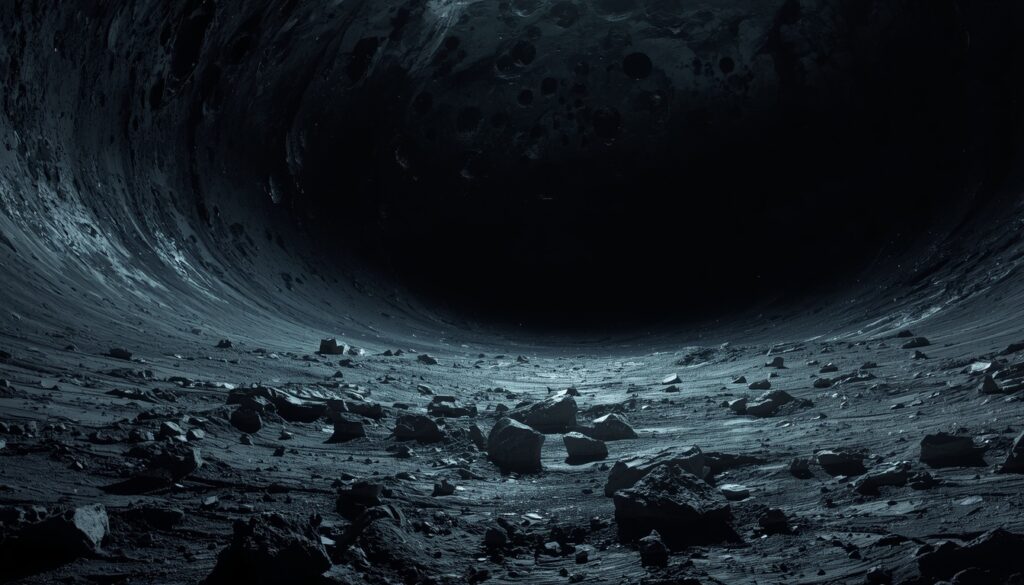
In October 2009, NASA deliberately crashed a spent rocket stage into Cabeus crater near the south pole, followed by the LCROSS shepherding spacecraft, which flew through the debris plume before impacting itself. Instruments detected water in the plume, estimated at around 5 percent by mass in the impact site’s soil.
LCROSS provided the first direct confirmation of water ice in a permanently shadowed crater. The impact was also watched by telescopes on Earth and by the Lunar Reconnaissance Orbiter, which measured the plume’s temperature and composition.
Water in Sunlit Regions Too
In 2020, NASA’s SOFIA airborne observatory detected water molecules in sunlit areas of the Moon, specifically in Clavius crater. The amounts were small, roughly equivalent to a 12-ounce bottle of water in a cubic meter of soil, but the discovery showed that water is not limited to shadowed craters.
Scientists think this water may be trapped in glass beads formed by micrometeorite impacts or hidden in tiny shadows between soil grains.
Chandrayaan-3 at the South Pole
India’s Chandrayaan-3 landed near the lunar south pole in August 2023, the first mission to touch down in that region. Its rover measured surface temperatures and detected elements like sulfur in the soil.
Although it did not directly detect ice, its data on temperature and soil properties helps scientists understand where ice could survive near the surface. Every south pole mission adds to the picture needed before astronauts arrive.
How Much Water Might Be There
Estimates of total lunar water vary widely, from hundreds of millions to billions of tonnes, depending on assumptions about how deep the ice extends and how evenly it is distributed. Much of this uncertainty exists because no spacecraft has yet directly sampled ice from inside a permanently shadowed crater.
Missions like VIPER and future landers are designed to reduce this uncertainty by measuring ice directly on the ground.
Turning Ice Into Resources
Lunar ice could be melted for drinking water, split into hydrogen and oxygen for breathing air and rocket propellant, and used for radiation shielding. Producing these resources on the Moon would reduce the need to launch heavy supplies from Earth.
This concept, known as in-situ resource utilization, is one of the main reasons the south pole has become the target for Artemis and other international programs.
A Race for the Same Craters
The United States, China, India, Russia and private companies all target the south pole because of its ice. That overlap has raised questions about how countries will share access to the most valuable craters, a topic now discussed under the Artemis Accords and at the United Nations.
The Ongoing Scientific Work to Map Ice Distribution
Following the initial Moon water ice discovery, subsequent missions including the VIPER rover have focused on more precisely mapping exactly where ice concentrations are highest and most accessible, since orbital detection alone cannot determine practical details like ice depth, purity, and ease of extraction that matter enormously for actual mining operations.
This ongoing mapping effort represents a critical bridge between the initial scientific discovery and the practical engineering challenge of actually extracting and processing lunar water ice at a scale meaningful for supporting permanent human habitation, a gap that current and near-future robotic missions are specifically designed to help close.
Keep exploring with our guides to lunar polar volatile compounds beyond water, Moon permanently shadowed craters and Moon south pole geography. For official information, visit NASA’s Artemis program page.
Frequently Asked Questions
When was the Moon water ice discovery confirmed?
Orbital data suggested ice presence in the mid-2000s, with NASA’s LCROSS mission providing direct confirmation in
2. Where is lunar water ice located?
Primarily within permanently shadowed craters near the Moon’s poles, especially the south pole.
Where did the Moon’s water ice come from?
Scientists believe ancient comet and asteroid impacts delivered the water, preserved by the extreme cold of shadowed craters.
How much water ice exists on the Moon?
Total quantity estimates remain uncertain and vary depending on region and measurement method.
Why does this discovery matter for Artemis?
It directly informs landing site selection, since accessible water ice could support drinking water, oxygen, and rocket fuel production.
1 comment