Mars Sample Return Mission: 6 Best Shocking Goals


Mars Sample Return Mission:
Every rover that has explored Mars has analyzed rock and soil samples using instruments carried aboard the spacecraft itself, but nothing compares to studying actual Martian material in Earth’s most sophisticated laboratories. This is the ambitious goal driving the Mars Sample Return mission, one of the most complex robotic space missions ever attempted.
1. Perseverance Has Already Collected the Samples
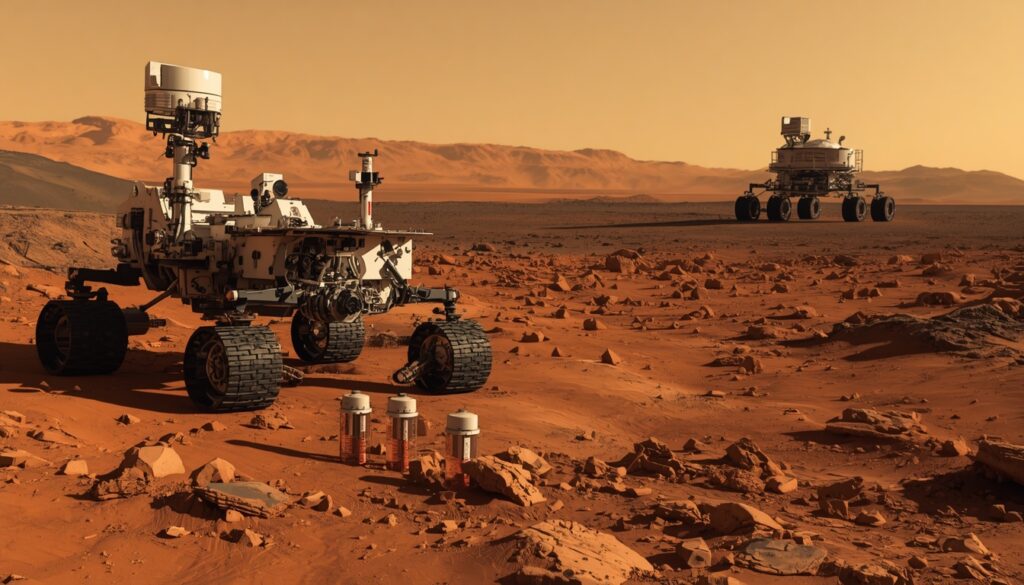
The Mars Sample Return mission builds directly on work already completed by NASA’s Perseverance rover, which has spent years collecting and sealing carefully selected rock and soil samples into specialized tubes left cached on the Martian surface awaiting eventual retrieval.
2. The Mission Requires Multiple Separate Spacecraft
Unlike a typical single-spacecraft mission, the Mars Sample Return mission involves a complex sequence of multiple vehicles, including a lander to retrieve cached samples, a rocket to launch them off the Martian surface, and an orbiter to capture and return them to Earth.
3. It Includes the First-Ever Rocket Launch From Another Planet
A landmark technical achievement planned within the mission involves launching a small rocket directly from the Martian surface into Mars orbit, an feat no spacecraft has ever previously attempted from any planetary surface beyond Earth and the Moon.
4. The Mission Has Faced Significant Cost and Schedule Pressure
Given its extraordinary technical complexity, the mission has faced substantial budget scrutiny and schedule adjustments, with NASA exploring various architecture changes and potential commercial partnerships to help manage the mission’s considerable projected costs.
5. Returned Samples Could Reveal Evidence of Past Life
Perhaps the most scientifically exciting aspect of the mission is the possibility that returned samples could contain evidence of ancient microbial life, a discovery that Earth-based laboratory analysis is far better equipped to identify conclusively than any instrument currently operating on Mars itself.
6. Strict Planetary Protection Protocols Will Govern Sample Handling
Given the remote possibility that Martian samples could contain some form of biological material, the mission includes extensive planetary protection protocols, ensuring returned samples are handled in specialized containment facilities to prevent any potential contamination risk to Earth’s biosphere.
Why Bringing Samples Home Matters So Much for Science
While rover-based instruments have provided invaluable Martian data for decades, they remain fundamentally limited compared to the full range of sophisticated laboratory equipment available on Earth, much of which is simply too large, complex, or power-hungry to ever operate aboard a Mars rover.
The mission would allow scientists to apply techniques including detailed isotopic analysis, high-resolution imaging, and chemical testing methods that could take years to fully analyze a single sample, offering scientific insight into Martian geology and potential past habitability that no robotic mission operating remotely on Mars could ever match.
How This Mission Connects to Future Human Exploration
Beyond its pure scientific value, the mission also generates practical engineering knowledge directly relevant to eventual human Mars missions, including validated techniques for launching from the Martian surface that any future crewed mission’s return journey will eventually need to replicate at a much larger scale.
This connection between robotic sample return technology and future human exploration reflects a broader pattern in space exploration, where robotic precursor missions consistently pave the way for the more ambitious crewed missions that follow, testing critical technologies and reducing risk before human lives depend on similar systems functioning correctly.
Where the Samples Are Now
Perseverance has sealed rock, soil and atmospheric samples in titanium tubes since 2021. The rover carries most of them onboard, while ten tubes were placed on the surface at a site called Three Forks in late 2022 and early 2023 as a backup cache. That backup depot means samples would be available even if the rover stopped working.
The samples come from different parts of Jezero Crater, including volcanic rocks on the crater floor and sedimentary rocks from the ancient river delta. Together, they represent a wide range of Martian history, which is exactly why the mission was ranked a top priority by scientists.
The Original Plan
The original NASA and ESA plan involved several spacecraft. A lander would carry a small rocket, the Mars Ascent Vehicle, to the surface. Samples would be loaded into the rocket, which would launch into Mars orbit. An ESA orbiter would capture the sample container and carry it back toward Earth, releasing a capsule to land on our planet.
Earlier plans also included small helicopters, inspired by Ingenuity’s success, to help retrieve sample tubes from the surface cache.
The Cost Problem
In 2023, an independent review board estimated the mission could cost between 8 and 11 billion dollars, far more than earlier projections, and warned that the planned timeline was unrealistic. The findings forced NASA to rethink the approach.
In 2024 and early 2025, NASA studied cheaper options, including using a sky crane landing system like the one used for Curiosity and Perseverance or relying on commercial partners. The mission’s future has since been caught up in wider US budget debates, so readers should check NASA’s latest announcements for its current status.
Why Samples Beat Rover Instruments
Rovers carry impressive instruments, but laboratories on Earth are vastly more capable. Scientists can use electron microscopes, mass spectrometers and techniques that do not yet exist to study samples in extreme detail.
Apollo samples show the value of this approach. Decades after the missions, scientists are still making discoveries using lunar rocks brought back in the 1960s and 1970s.
China’s Competing Plan
China plans its own Mars sample return mission, Tianwen-3, targeted for launch around 2028, with samples returning to Earth around 2031. If successful, it could become the first mission to return samples from Mars.
This possibility has added competitive pressure to NASA’s plans, similar to the space race dynamics of the past.
Protecting Earth and Mars
Returned samples would be treated as potentially hazardous until proven safe, handled in a special facility with strict containment similar to high-level biosafety labs. This approach protects Earth from any unknown material.
Scientists consider the risk extremely low, but planetary protection rules require caution. The same principles guide how spacecraft are cleaned before visiting Mars.
What Scientists Hope to Learn
Scientists hope samples will reveal whether Mars ever hosted microbial life, how its climate changed and how its water disappeared. They could also help assess hazards for future astronauts, such as toxic dust.
Even without signs of life, the samples would dramatically improve understanding of Mars’s history.
Keep exploring with our guides to Mars sample contamination protocols, Artemis 3 moon landing, VIPER lunar rover mission and Phobos and Deimos Mars moons exploration. For official information, visit NASA’s Mars science hub.
Frequently Asked Questions
What is the Mars Sample Return mission?
A mission designed to bring rock and soil samples collected on Mars back to Earth for detailed laboratory analysis.
Who collected the samples for this mission?
NASA’s Perseverance rover has been collecting and caching samples on the Martian surface.
Why is launching from Mars so significant?
It would be the first-ever rocket launch from the surface of another planet.
Could the samples contain evidence of life?
Scientists hope returned samples might reveal evidence of ancient microbial life, though this remains uncertain.
Why not just analyze samples on Mars with rover instruments?
Earth-based laboratories offer far more sophisticated equipment than anything that can operate aboard a Mars rover.